Cement
- Introduction
Cement is a fine powder obtained by grinding a mixture of limestone and clay, which when mixed with water forms a paste that sets and hardens, binding other materials together.
👉 In simple words: Cement is a binding material used to make mortar and concrete.
- Core Concepts
- Raw Materials of Cement
Main raw materials:
| Material | Function |
| Limestone | Provides calcium |
| Clay | Provides silica & alumina |
| Gypsum | Controls setting time |
- Manufacturing Process of Cement
This is a very important exam topic.
Step 1: Crushing and Grinding
- Limestone and clay are crushed
- Ground to fine powder
Step 2: Mixing of Raw Materials
Two methods:
- Wet process
- Dry process (most common)
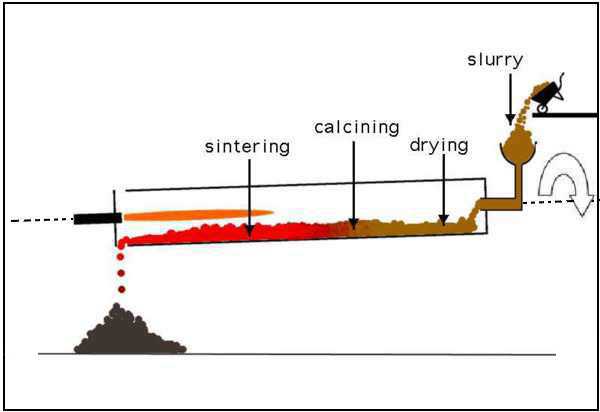
Step 3: Burning in Rotary Kiln
- Temperature: 1400°C – 1500°C
- Forms hard nodules called clinker
Step 4: Grinding of Clinker
- Clinker is ground with 3–5% gypsum
- Produces Portland cement
- Composition of Cement
| Compound | Function |
| Lime (CaO) | Strength |
| Silica (SiO₂) | Hardness |
| Alumina (Al₂O₃) | Quick setting |
| Iron oxide (Fe₂O₃) | Colour & strength |
| Gypsum | Controls setting |
- Types of Cement
| Type | Use |
| Ordinary Portland Cement (OPC) | General construction |
| Portland Pozzolana Cement (PPC) | Mass concrete |
| Rapid Hardening Cement | Road works |
| Low Heat Cement | Dams |
| Sulphate Resisting Cement | Marine works |
- Properties of Cement
| Property | Purpose |
| Setting time | Workability |
| Soundness | Volume stability |
| Strength | Load carrying |
| Fineness | Rate of hydration |
- Uses of Cement
- Making concrete
- Masonry mortar
- Plastering
- RCC works
- Step-by-Step Practical Examples
Example 1: Choosing Cement for Dam Construction
Problem:
Which cement is suitable for a dam?
Step 1: Identify requirement
Dam produces large heat.
Step 2: Match cement type
Low heat cement produces less heat.
➡ Answer: Low Heat Cement
Example 2: Function of Gypsum in Cement
Question:
Why is gypsum added to cement?
Step 1: Observe property
Without gypsum, cement sets too quickly.
Step 2: Identify role
Gypsum controls setting time.
➡ Gypsum prevents flash setting
- Description of Diagram (Manufacture of Cement)
A flow diagram:
Limestone + Clay → Crushing → Grinding → Mixing → Rotary Kiln (Clinker) → Grinding with Gypsum → Cement
Each step in a rectangular box connected by arrows.
This diagram helps remember manufacturing steps in order.
- Exam Focus: Must-Know Points ⭐
- Cement is a binding material that sets with water.
- Clinker is formed in a rotary kiln at 1400°C – 1500°C.
- Gypsum controls setting time of cement.
- OPC is used for general construction.
- Low heat cement is used for dams.
- Multiple Choice Questions (MCQs)
- Cement mainly acts as a:
- Aggregate
B. Binding material
C. Filler
D. Reinforcement
Answer: B
Explanation: Cement binds sand and aggregates.
- Main raw material of cement is:
- Sand
B. Limestone
C. Gypsum
D. Clay
Answer: B
Explanation: Limestone provides calcium.
- Which material controls setting time of cement?
- Clay
B. Silica
C. Gypsum
D. Iron oxide
Answer: C
Explanation: Gypsum prevents quick setting.
- Temperature in rotary kiln is about:
- 500°C
B. 900°C
C. 1200°C
D. 1450°C
Answer: D
Explanation: Clinker forms at 1400–1500°C.
- Clinker is obtained in:
- Crusher
B. Grinder
C. Rotary kiln
D. Mixer
Answer: C
Explanation: Burning in kiln forms clinker.
- Cement used for marine works is:
- OPC
B. PPC
C. Rapid hardening
D. Sulphate resisting
Answer: D
Explanation: Resists sulphate attack.
- Cement used for road repair works is:
- OPC
B. Rapid hardening
C. Low heat
D. PPC
Answer: B
Explanation: Gains strength quickly.
- Which cement is used for mass concrete works?
- PPC
B. OPC
C. Rapid hardening
D. White cement
Answer: A
Explanation: PPC produces less heat.
- Fineness of cement mainly affects:
- Colour
B. Strength gain
C. Weight
D. Soundness
Answer: B
Explanation: Finer cement hydrates faster.
- Soundness test checks:
- Strength
B. Setting time
C. Volume stability
D. Colour
Answer: C
Explanation: Prevents expansion after setting.
- Alumina in cement causes:
- Slow setting
B. Quick setting
C. No effect
D. Colour change
Answer: B
Explanation: Alumina speeds up setting.
- Iron oxide gives cement:
- Strength only
B. Colour only
C. Strength and colour
D. Hardness only
Answer: C
Explanation: Fe₂O₃ improves strength and colour.
- Low heat cement is used for:
- Bridges
B. Dams
C. Roads
D. Buildings
Answer: B
Explanation: Reduces thermal cracks.
- Cement mixed with sand and water is called:
- Concrete
B. Mortar
C. Paste
D. Grout
Answer: B
Explanation: Mortar = cement + sand + water.
- Which cement is used for decorative works?
- White cement
B. OPC
C. PPC
D. SRC
Answer: A
Explanation: White cement is used for finish.
- Rapid hardening cement is obtained by:
- Adding lime
B. Adding gypsum
C. Finer grinding
D. Adding sand
Answer: C
Explanation: Finer grinding increases hydration rate.
- Main function of silica in cement is:
- Colour
B. Strength
C. Setting control
D. Expansion
Answer: B
Explanation: Silica increases strength.
- Cement stored for long time becomes:
- Stronger
B. Lighter
C. Lumpy
D. Coloured
Answer: C
Explanation: Moisture causes lump formation.
- OPC stands for:
- Ordinary Portland Cement
B. Original Portland Cement
C. Ordinary Pozzolana Cement
D. Open Portland Cement
Answer: A
Explanation: OPC is general-purpose cement.
- Which test checks early setting of cement?
- Soundness test
B. Setting time test
C. Fineness test
D. Strength test
Answer: B
Explanation: Setting time test measures initial and final set.
About the Author