

Building Materials – Bricks & Clay Products | Complete JE Exam Guide
(For SSC JE, RRB JE, OSSC JE – Civil Engineering)
🔶 1. Concept Explanation (Exam-Focused)
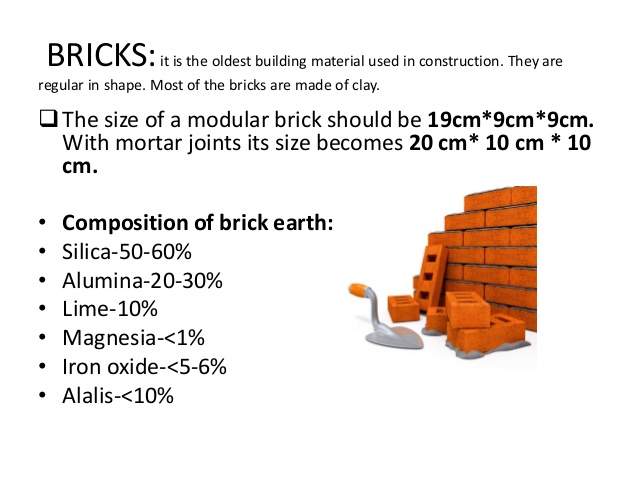
1. Composition of Brick Earth
Good brick earth should contain the following constituents in proper proportion:
-
Alumina (20–30%)
Provides plasticity for molding bricks.
👉 Excess → high shrinkage & cracking -
Silica (50–60%)
Prevents shrinkage and warping.
👉 Excess → brittle bricks -
Lime (5–10%)
Helps fusion during burning and improves strength.
👉 Excess → lime blowing -
Iron Oxide (5–7%)
Imparts red color and hardness. -
Magnesia (≤1%)
Reduces shrinkage, excess gives yellow tint.
📌 Key Theory: Alumina + Silica balance decides brick quality (very common JE question).
2. Manufacturing Process of Bricks
-
Preparation of Clay – Unsoiling, digging, weathering, blending
-
Moulding – Hand moulding / Machine moulding
-
Drying – 7–14 days, removes free moisture
-
Burning – 900°C–1100°C in clamp or kiln
📌 Exam Note:
-
Clamp → irregular, cheaper
-
Kiln → uniform, better quality bricks
3. Classification of Bricks
-
First Class Bricks – Table moulded, kiln burnt, high strength
-
Second Class Bricks – Ground moulded, slight defects
-
Third Class Bricks – Under-burnt, temporary works
-
Fourth Class Bricks – Over-burnt, used as aggregates
4. Tests on Bricks
-
Compressive Strength Test
-
Water Absorption Test
-
Efflorescence Test
-
Dimensional Tolerance Test
📌 Water absorption ≤ 20% (first-class bricks)
5. Clay Products
-
Tiles – Roofing, flooring
-
Stoneware Pipes – Sewer lines
-
Fire Clay Bricks – Refractory use
-
Terracotta – Architectural works
🔶 2. Important Formulas (JE Repeated)
Compressive Strength of Brick
fc=PAf_c = \frac{P}{A}
Where:
-
PP = Load at failure (N)
-
AA = Loaded area (mm²)
-
fcf_c = Compressive strength (N/mm²)
📌 JE Trick: “P/A = Power of Brick”
Water Absorption
Water Absorption (%)=W2−W1W1×100\text{Water Absorption (\%)} = \frac{W_2 – W_1}{W_1} \times 100
🔶 3. Short Notes / One-Liners
-
Standard brick size (India): 190 × 90 × 90 mm
-
Nominal size with mortar: 200 × 100 × 100 mm
-
Frog improves bond & strength
-
Efflorescence caused due to alkaline salts
-
Ideal burning temperature: 1000°C
🔶 4. PYQ Patterns (JE Exams)
✔ Repeated focus on:
-
Composition percentages
-
Water absorption limits
-
Brick dimensions
-
First vs Second class bricks
✔ Trap: Mixing lime defects with iron oxide effects
🔶 5. Solved Examples
Example 1 (Numerical – SSC JE)
A brick fails at 180 kN. Area = 19,000 mm².
Find compressive strength.
fc=18000019000=9.47 N/mm2f_c = \frac{180000}{19000} = 9.47 \text{ N/mm}^2
✅ Answer: 9.47 N/mm²
Example 2 (Conceptual)
Which ingredient gives plasticity to brick earth?
👉 Alumina



🔶 30. MCQs (Exam Level – All in One)
1. Maximum water absorption for first-class bricks is:
A) 15% B) 20% C) 25% D) 30%
✅ Ans: B – IS code limit
2. Red color of brick is due to:
A) Lime B) Silica C) Iron Oxide D) Alumina
✅ Ans: C
3. Over-burnt bricks are used as:
A) Facing bricks B) Aggregate C) Flooring D) Roofing
✅ Ans: B
4. Frog in brick is provided to:
A) Reduce weight
B) Increase strength
C) Improve bond
D) Decorative purpose
✅ Ans: C
5. The plasticity of brick earth is mainly due to
A) Silica
B) Alumina
C) Lime
D) Iron oxide
✅ Answer: B
📝 Alumina provides plasticity required for moulding bricks.
6. Excess of lime in brick earth causes
A) Cracking
B) Warping
C) Lime blowing
D) Loss of strength
✅ Answer: C
📝 Free lime expands after burning, causing disintegration.
7. Which constituent gives hardness and durability to bricks?
A) Alumina
B) Silica
C) Magnesia
D) Lime
✅ Answer: B
📝 Silica prevents shrinkage and adds strength.
8. Standard compressive strength of first-class bricks should not be less than
A) 3.5 N/mm²
B) 7.0 N/mm²
C) 10.5 N/mm²
D) 14.0 N/mm²
✅ Answer: B
📝 IS standard minimum value for first-class bricks.
9. Which brick is used only for temporary structures?
A) First class
B) Second class
C) Third class
D) Fourth class
✅ Answer: C
📝 Third-class bricks are under-burnt and weak.
10. Efflorescence in bricks is caused by
A) Iron oxide
B) Silica
C) Alkali salts
D) Lime
✅ Answer: C
📝 White patches appear due to soluble salts.
11. Water absorption of a good brick should be
A) <10%
B) <15%
C) <20%
D) <25%
✅ Answer: C
📝 As per IS code for first-class bricks.
12. Frog in a brick helps in
A) Reducing cost
B) Increasing strength
C) Improving bond
D) Decoration
✅ Answer: C
📝 Frog improves mortar grip.
13. Which is NOT a clay product?
A) Roofing tiles
B) Stoneware pipes
C) Fire clay bricks
D) Fly ash bricks
✅ Answer: D
📝 Fly ash bricks are not clay-based.
14. The burning temperature of bricks ranges between
A) 400–600°C
B) 600–800°C
C) 900–1100°C
D) 1200–1400°C
✅ Answer: C
📝 Ideal range for proper vitrification.
15. Which kiln gives uniform quality bricks?
A) Clamp
B) Bull’s trench kiln
C) Open fire
D) Temporary kiln
✅ Answer: B
📝 Continuous kilns ensure uniform burning.
16. Over-burnt bricks are generally used for
A) Masonry
B) Flooring
C) Aggregate
D) Facing work
✅ Answer: C
📝 They are brittle and unsuitable for masonry.
17. The nominal size of a brick is
A) 190 × 90 × 90 mm
B) 200 × 100 × 100 mm
C) 230 × 110 × 75 mm
D) 210 × 100 × 100 mm
✅ Answer: B
📝 Includes mortar thickness.
18. Which test checks soluble salts in bricks?
A) Crushing test
B) Water absorption test
C) Efflorescence test
D) Hardness test
✅ Answer: C
19. A brick absorbs 18% water. It is classified as
A) First class
B) Second class
C) Third class
D) Rejected
✅ Answer: A
📝 Water absorption ≤ 20%.
20. Iron oxide in brick earth provides
A) Strength
B) Plasticity
C) Color
D) Durability
✅ Answer: C
21. Excess silica in brick earth makes bricks
A) Weak
B) Brittle
C) Soft
D) Plastic
✅ Answer: B
22. Which defect is caused due to excess alumina?
A) Lime blowing
B) Warping
C) Cracking
D) Efflorescence
✅ Answer: C
23. Stoneware pipes are mainly used for
A) Water supply
B) Sewer lines
C) Gas lines
D) Electrical conduits
✅ Answer: B
24. Fire clay bricks are used for
A) Flooring
B) Roofing
C) Furnace lining
D) Masonry walls
✅ Answer: C
25. Which brick gives maximum strength?
A) Hand-moulded
B) Ground-moulded
C) Table-moulded
D) Sun-dried
✅ Answer: C
26. Dimensional tolerance test checks
A) Strength
B) Shape
C) Size accuracy
D) Durability
✅ Answer: C
27. Under-burnt bricks are
A) Hard and strong
B) Brittle
C) Soft and weak
D) Glassy
✅ Answer: C
28. Magnesia content in brick earth should not exceed
A) 1%
B) 5%
C) 10%
D) 15%
✅ Answer: A
29. Which brick defect shows white patches on surface?
A) Cracking
B) Warping
C) Efflorescence
D) Bloating
✅ Answer: C
30. The test conducted to determine load-carrying capacity of brick is
A) Water absorption
B) Efflorescence
C) Compression test
D) Shape test
✅ Answer: C
✅ Exam Tip (JE Short Trick)
“ASP-LIM” for Brick Earth
Alumina – Plasticity
Silica – Strength
Proportion – Balance
Lime – Fusion
Iron oxide – Color
Magnesia – Shrinkage control