


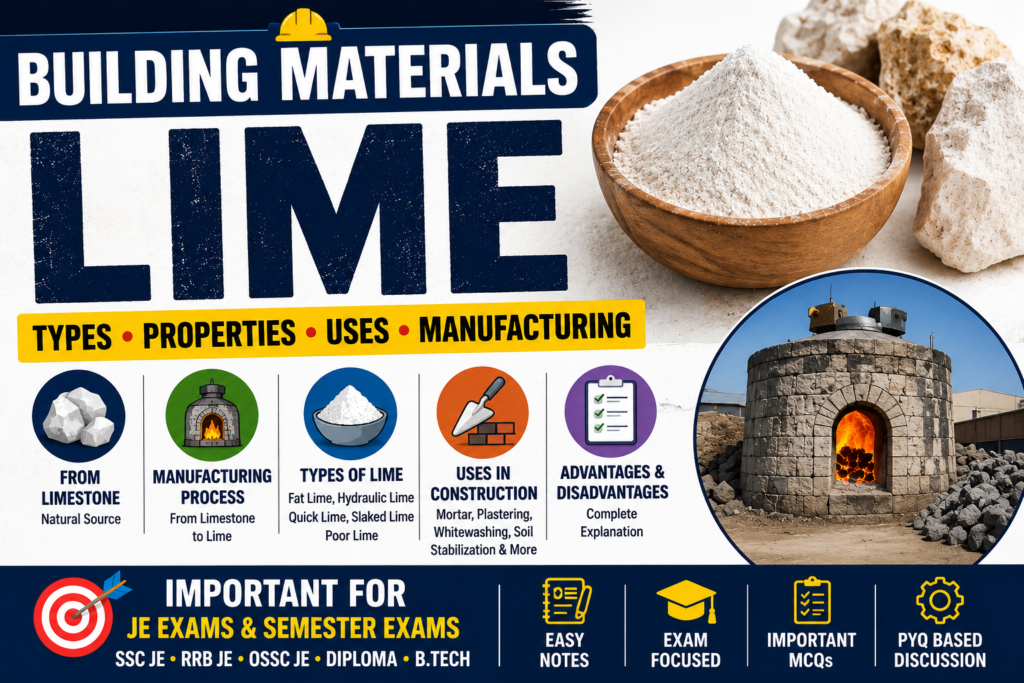
Building Materials – Lime
What is Lime?
Lime is a binding material obtained by heating limestone (Calcium Carbonate) in a kiln. It mainly contains calcium oxide (CaO) and is used in construction works.
Chemical Formula of Lime
CaCO3HeatCaO+CO2
Where:
- CaCO₃ = Limestone
- CaO = Quick Lime
- CO₂ = Carbon Dioxide
Types of Lime
Lime is classified based on its properties and composition.
| Type of Lime | Description | Main Use |
| Fat Lime | Contains high calcium oxide | Whitewashing & plastering |
| Hydraulic Lime | Sets under water | Masonry & construction |
| Poor Lime | Contains impurities | Low-quality works |
| Quick Lime | Obtained after burning limestone | Cement & mortar |
| Slaked Lime | Produced by adding water to quick lime | Plaster & mortar |
Fat Lime
Characteristics of Fat Lime
- White in color
- High plasticity
- Slakes vigorously with water
- Hardens slowly
- Pure calcium lime
Uses of Fat Lime
- Whitewashing
- Plastering
- Mortar preparation
- Decorative works
Hydraulic Lime
Hydraulic lime can set under water due to the presence of clay and silica.
Types of Hydraulic Lime
1. Feebly Hydraulic Lime
- Contains less clay
- Slow setting
2. Moderately Hydraulic Lime
- Medium strength
- Used in masonry work
3. Eminently Hydraulic Lime
- Strongest hydraulic lime
- Used in underwater structures
Manufacturing Process of Lime
The manufacturing of lime involves the following steps:
1. Collection of Limestone
Limestone is collected from quarries.
2. Burning
Limestone is heated in kilns at high temperature.
3. Cooling
The burnt lime is cooled carefully.
4. Slaking
Water is added to quick lime.
5. Grinding and Storage
The lime is ground and stored for use.
Slaking of Lime
Slaking is the process of adding water to quick lime.
Chemical Reaction
$$ CaO + H_2O \rightarrow Ca(OH)_2 + Heat $$
This process produces slaked lime.
Properties of Good Lime
A good quality lime should have:
- High binding property
- White color
- Fine texture
- Free from impurities
- Good plasticity
- Proper setting time
- Durable nature
Uses of Lime in Construction
1. Mortar Preparation
Lime mortar is used in brick masonry.
2. Plastering
Provides smooth wall finish.
3. Whitewashing
Used for decorative wall coating.
4. Soil Stabilization
Improves soil strength in road construction.
5. Manufacturing of Cement
Important ingredient in cement production.
6. Water Treatment
Used for purification purposes.
Advantages of Lime
| Advantages | Explanation |
| Easy Workability | Easy to mix and apply |
| Economical | Low construction cost |
| Durable | Long-lasting material |
| Environment Friendly | Lower carbon impact |
| Good Binding Property | Strong bonding in masonry |
Disadvantages of Lime
| Disadvantages | Explanation |
| Slow Setting | Takes time to harden |
| Low Early Strength | Weak compared to cement |
| Moisture Sensitive | Affected by water |
| Not Suitable for Heavy Loads | Lower compressive strength |
Difference Between Lime and Cement
| Lime | Cement |
| Slow setting | Fast setting |
| Lower strength | Higher strength |
| More workable | Less workable |
| Used in traditional construction | Used in modern construction |
| Economical | Costlier |
Important Properties for JE Exams
Important SSC JE/RRB JE Points
- Quick lime is obtained by burning limestone.
- Slaked lime is produced after adding water to quick lime.
- Hydraulic lime can set under water.
- Fat lime contains approximately 95% calcium oxide.
- Lime mortar has better workability than cement mortar.
Formula Section
Lime Manufacturing Formula
CaCO3→HeatCaO+CO2CaCO_3 \xrightarrow{Heat} CaO + CO_2CaCO3HeatCaO+CO2
Slaking Formula
$$ CaO + H_2O \rightarrow Ca(OH)_2 $$
Important MCQs on Lime
1. Which lime sets under water?
A) Fat Lime
B) Quick Lime
C) Hydraulic Lime
D) Poor Lime
Answer:
C) Hydraulic Lime
2. Lime is mainly obtained from:
A) Granite
B) Limestone
C) Sandstone
D) Marble
Answer:
B) Limestone
3. The chemical formula of quick lime is:
A) CaCO₃
B) Ca(OH)₂
C) CaO
D) MgO
Answer:
C) CaO
4. Slaked lime is chemically known as:
A) Calcium Oxide
B) Calcium Hydroxide
C) Calcium Carbonate
D) Magnesium Oxide
Answer:
B) Calcium Hydroxide
5. Which lime has high calcium content?
A) Hydraulic Lime
B) Poor Lime
C) Fat Lime
D) Kankar Lime
Answer:
C) Fat Lime
PYQ Related Discussion
Frequently Asked JE Exam Questions
Previous year SSC JE and RRB JE exams commonly ask:
- Types of lime
- Chemical composition of lime
- Hydraulic lime properties
- Difference between lime and cement
- Slaking process
- Uses of lime in construction
Preparation Tip:
Focus on:
- Chemical formulas
- Types and properties
- Manufacturing process
- Important uses
These areas are highly repeated in JE exams.
FAQs on Lime
What is lime in building materials?
Lime is a binding material obtained from limestone and used in construction works like plastering, mortar, and whitewashing.
What are the main types of lime?
The main types are:
- Fat Lime
- Hydraulic Lime
- Poor Lime
- Quick Lime
- Slaked Lime
What is hydraulic lime?
Hydraulic lime is a type of lime that can set under water due to the presence of clay impurities.
What is slaking of lime?
Slaking is the process of adding water to quick lime to produce slaked lime.
Why is lime important in civil engineering?
Lime improves workability, binding strength, and durability in construction materials.