


Introduction
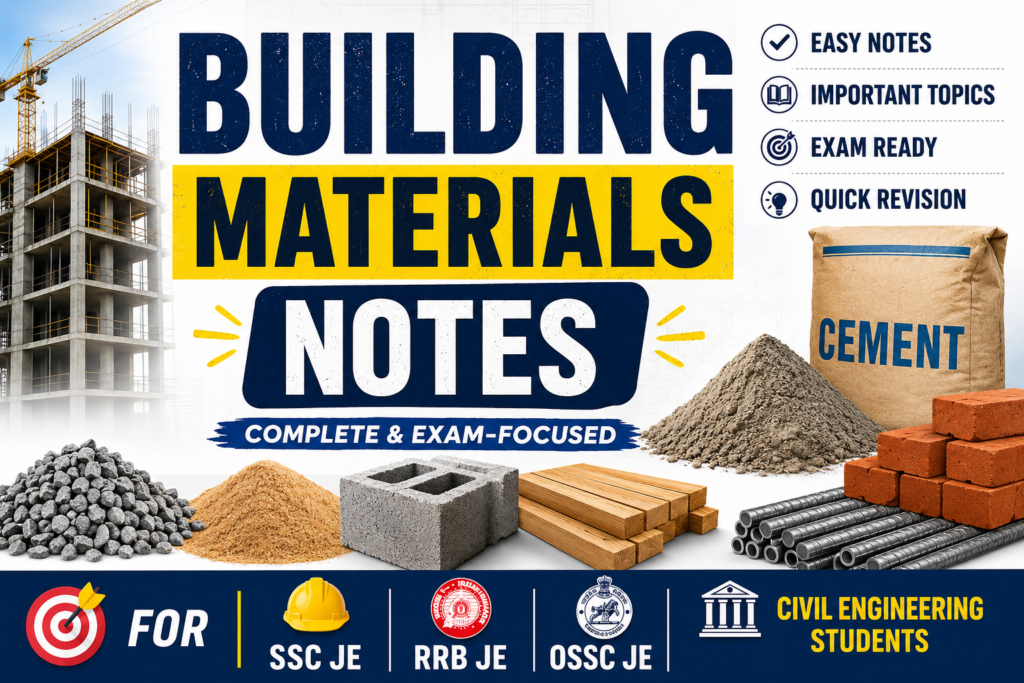
Building materials are the backbone of every construction project. From small residential houses to massive bridges and dams, proper selection of building materials ensures strength, durability, safety, and economy.
For competitive exams like SSC JE, RRB JE, OSSC JE, and diploma/B.Tech civil engineering exams, Building Materials is one of the most important scoring subjects. Questions are frequently asked from:
- Cement
- Lime
- Bricks
- Stone
- Timber
- Steel
- Glass
- Plastics
- Bitumen
- Concrete
This article provides complete Building Materials Notes, including definitions, properties, manufacturing processes, advantages, disadvantages, MCQs, PYQs, and exam-focused revision points.
What Are Building Materials?
Building materials are materials used for construction purposes such as:
- Buildings
- Roads
- Bridges
- Dams
- Railway structures
They provide:
- Strength
- Stability
- Durability
- Thermal protection
- Sound insulation
- Aesthetic appearance
Types of Building Materials
1. Natural Building Materials
Materials obtained directly from nature.
Examples:
- Stone
- Timber
- Sand
- Clay
Features
- Eco-friendly
- Easily available
- Low processing cost
2. Artificial Building Materials
Manufactured by industrial processes.
Examples:
- Cement
- Bricks
- Steel
- Concrete
- Glass
Features
- High strength
- Better durability
- Uniform quality
Important Properties of Good Building Materials
| Property | Description |
| Strength | Ability to withstand load |
| Durability | Resistance against weathering |
| Hardness | Resistance to wear and abrasion |
| Toughness | Resistance to impact |
| Workability | Ease of handling and shaping |
| Fire Resistance | Ability to resist fire |
| Water Resistance | Resistance against moisture |
| Thermal Insulation | Reduces heat transfer |
| Sound Insulation | Reduces sound transmission |
| Economy | Affordable and easily available |
Cement
Definition
Cement is a binding material used in construction that hardens after mixing with water.
Types of Cement
| Type | Uses |
| Ordinary Portland Cement (OPC) | General construction |
| Portland Pozzolana Cement (PPC) | Durable structures |
| Rapid Hardening Cement | Road works |
| Low Heat Cement | Dams |
| Sulphate Resistant Cement | Marine structures |
| White Cement | Decorative works |
Manufacturing Process of Cement
1. Dry Process
- Raw materials are crushed
- Powdered materials mixed
- Heated in rotary kiln
- Clinker formed
- Gypsum added
- Grinding done
2. Wet Process
- Raw materials mixed with water
- Slurry formed
- Burned in kiln
Advantages of Cement
- High compressive strength
- Durable
- Easily available
- Economical
Disadvantages of Cement
- Low tensile strength
- Shrinkage cracks
- Environmental pollution during production
Uses of Cement
- Concrete production
- Plastering
- Flooring
- RCC structures
- Bridges and dams
Bricks
Definition
Bricks are artificial stone-like blocks made from clay.
Types of Bricks
| Type | Characteristics |
| First Class Brick | High quality |
| Second Class Brick | Moderate quality |
| Third Class Brick | Temporary structures |
| Fourth Class Brick | Broken and crushed |
Manufacturing Process of Bricks
Steps
- Preparation of clay
- Moulding
- Drying
- Burning
Properties of Good Bricks
- Uniform shape
- Sharp edges
- Hard texture
- Free from cracks
- Water absorption less than 20%
Advantages of Bricks
- Fire resistant
- Durable
- Good thermal insulation
Disadvantages of Bricks
- Time-consuming construction
- Less tensile strength
- Heavier dead load
Uses of Bricks
- Walls
- Foundations
- Arches
- Pavements
Stones
Definition
Stone is a naturally available construction material obtained from rocks.
Types of Stones
| Stone | Uses |
| Granite | Heavy construction |
| Basalt | Road metal |
| Marble | Decorative work |
| Sandstone | Masonry work |
| Limestone | Cement manufacture |
Properties of Good Stone
- Strong
- Durable
- Weather resistant
- Fine texture
Timber
Definition
Timber is wood suitable for engineering and construction purposes.
Types of Timber
| Type | Example |
| Softwood | Pine |
| Hardwood | Teak |
Advantages
- Lightweight
- Easy to work
- Good insulation
Disadvantages
- Fire risk
- Termite attack
- Shrinkage
Uses
- Doors
- Windows
- Furniture
- Roof trusses
Steel
Definition
Steel is an alloy of iron and carbon used for reinforcement and structural work.
Properties of Steel
- High tensile strength
- Ductility
- Elasticity
- Durability
Advantages
- High strength-to-weight ratio
- Recyclable
- Long life
Disadvantages
- Corrosion
- Expensive
- Requires maintenance
Concrete
Definition
Concrete is a mixture of cement, sand, aggregate, and water.
Types of Concrete
| Type | Uses |
| Plain Cement Concrete (PCC) | Flooring |
| Reinforced Cement Concrete (RCC) | Structural members |
| Prestressed Concrete | Bridges |
| Lightweight Concrete | Insulation works |
Advantages
- High compressive strength
- Durable
- Moldable
Disadvantages
- Low tensile strength
- Heavy weight
- Shrinkage cracks
Comparison Table: Cement vs Lime
| Feature | Cement | Lime |
| Strength | High | Moderate |
| Setting Time | Fast | Slow |
| Cost | Higher | Lower |
| Durability | Better | Less |
| Uses | RCC work | Mortar and plaster |
Comparison Table: Brick vs Stone Masonry
| Feature | Brick Masonry | Stone Masonry |
| Cost | Economical | Expensive |
| Strength | Moderate | High |
| Fire Resistance | Better | Moderate |
| Appearance | Uniform | Natural |
Important Exam Points for SSC JE & RRB JE
Frequently Asked Facts
- Initial setting time of cement = 30 minutes
- Final setting time = 10 hours
- Standard brick size = 19 × 9 × 9 cm
- Water absorption of first-class brick < 20%
- Lime improves workability
- Granite is hardest building stone
- Teak is best timber for construction
- PPC generates less heat than OPC
Building Materials MCQ
1. Which cement is used for marine structures?
A. OPC
B. PPC
C. Sulphate Resistant Cement
D. White Cement
Answer:
C. Sulphate Resistant Cement
2. Standard size of brick is:
A. 20 × 10 × 10 cm
B. 19 × 9 × 9 cm
C. 18 × 8 × 8 cm
D. 23 × 11 × 7 cm
Answer:
B. 19 × 9 × 9 cm
3. Which stone is used for decorative purposes?
A. Basalt
B. Granite
C. Marble
D. Limestone
Answer:
C. Marble
4. Which material has high tensile strength?
A. Brick
B. Cement
C. Steel
D. Lime
Answer:
C. Steel
5. Which timber is classified as hardwood?
A. Pine
B. Cedar
C. Teak
D. Fir
Answer:
C. Teak
Previous Year Questions (PYQs)
SSC JE PYQ
Question:
Which cement produces less heat during hydration?
A. OPC
B. Rapid Hardening Cement
C. Low Heat Cement
D. White Cement
Answer:
C. Low Heat Cement
RRB JE PYQ
Question:
The water absorption of first-class bricks should not exceed:
A. 10%
B. 15%
C. 20%
D. 25%
Answer:
C. 20%
OSSC JE PYQ
Question:
Which rock is mainly used in cement manufacturing?
A. Granite
B. Limestone
C. Marble
D. Basalt
Answer:
B. Limestone
FAQs on Building Materials
What are building materials in civil engineering?
Building materials are materials used for construction such as cement, steel, bricks, timber, and concrete.
Which topic is most important in SSC JE Building Materials?
Cement, bricks, concrete, timber, and steel are highly important topics.
What is the standard size of brick?
Standard modular brick size is 19 × 9 × 9 cm.
Which cement is best for RCC work?
Ordinary Portland Cement (OPC) is widely used for RCC structures.
Why is steel used in RCC?
Steel provides tensile strength to reinforced concrete.
Conclusion
Building Materials is a core subject in civil engineering and competitive exams like SSC JE, RRB JE, and OSSC JE. Understanding the properties, uses, advantages, and manufacturing processes of materials helps students solve both theoretical and numerical questions effectively.