


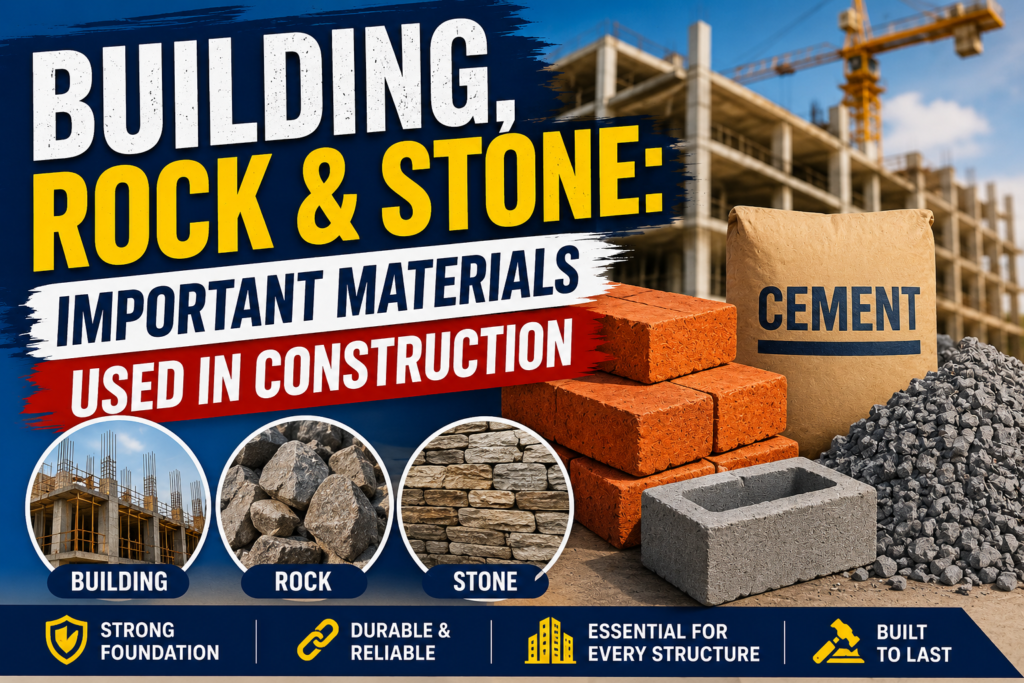
Building, Rock & Stone: Important Materials Used in Construction
Introduction
Buildings, roads, bridges, and monuments are made using different construction materials. Among the oldest and strongest materials are building stones and rocks. These natural materials have been used for thousands of years because of their durability, strength, and beautiful appearance.
Understanding rocks and stones is very important for civil engineering students, construction workers, architects, and anyone interested in building materials. In this article, we will learn about the types of rocks, building stones, their properties, uses, advantages, and importance in construction work.
What Are Rocks?
Rocks are natural solid materials found in the earth’s crust. They are made of minerals and are formed naturally over many years.
Rocks are the basic source of many building materials used in construction.
Main Types of Rocks
Rocks are mainly divided into three types:
| Type of Rock | Formation Method | Example |
| Igneous Rocks | Formed from cooling magma | Granite, Basalt |
| Sedimentary Rocks | Formed by deposition of particles | Sandstone, Limestone |
| Metamorphic Rocks | Formed due to heat and pressure | Marble, Slate |
Igneous Rocks
Igneous rocks are formed when molten magma cools and becomes solid.
Characteristics of Igneous Rocks
- Very hard and strong
- Durable in nature
- Resistant to weather
- Good for heavy construction
Examples
Granite
Granite is widely used in:
- Flooring
- Kitchen slabs
- Bridges
- Monuments
Basalt
Basalt is commonly used in:
- Road construction
- Railway ballast
- Concrete aggregate
Sedimentary Rocks
Sedimentary rocks are formed by the accumulation of sediments over time.
Characteristics
- Softer compared to igneous rocks
- Layered structure
- Easy to cut and shape
Examples
Sandstone
Used for:
- Building walls
- Decorative works
- Paving
Limestone
Used in:
- Cement manufacturing
- Building blocks
- Lime production
Metamorphic Rocks
Metamorphic rocks are formed when existing rocks change due to heat and pressure.
Characteristics
- Attractive appearance
- Hard and compact
- Smooth texture
Examples
Marble
Commonly used for:
- Flooring
- Sculptures
- Interior decoration
Slate
Used in:
- Roofing tiles
- Blackboards
- Flooring
What Are Building Stones?
Building stones are natural rocks cut and shaped for construction purposes.
They are used in:
- Foundations
- Walls
- Floors
- Bridges
- Dams
Properties of Good Building Stones
A good building stone should have the following qualities:
1. Strength
The stone must withstand heavy loads.
2. Durability
It should resist weathering and decay.
3. Hardness
The stone should resist wear and tear.
4. Toughness
It must absorb shocks and vibrations.
5. Water Resistance
Low water absorption increases durability.
6. Appearance
Good color and texture improve aesthetics.
Common Building Stones and Their Uses
| Stone | Main Use |
| Granite | Heavy structures |
| Marble | Decoration and flooring |
| Sandstone | Wall construction |
| Slate | Roofing |
| Limestone | Cement production |
| Basalt | Road works |
Advantages of Building Stones
Long Life
Stones are very durable and can last for hundreds of years.
Fire Resistance
Most stones resist fire better than wood.
Strong Construction Material
They provide excellent strength for structures.
Natural Appearance
Stones improve the beauty of buildings.
Disadvantages of Building Stones
- Heavy weight
- Difficult transportation
- Requires skilled labor
- Higher construction cost in some areas
Important Tests on Building Stones
Engineers perform several tests to check stone quality.
Crushing Strength Test
Measures the load-carrying capacity.
Water Absorption Test
Checks water resistance.
Abrasion Test
Measures resistance against wear.
Hardness Test
Checks resistance to scratches.
Uses of Rocks and Stones in Civil Engineering
Rocks and stones are widely used in civil engineering projects such as:
- Roads
- Bridges
- Buildings
- Retaining walls
- Railway tracks
- Dams
They are also used as aggregates in concrete.
Real-Life Example
The famous Taj Mahal is made mainly of white marble. This shows the beauty and durability of natural stone in construction.
Another example is the Konark Sun Temple, which was constructed using stone materials and still stands strong after centuries.
Formula Used in Stone Testing
The compressive strength of stone can be calculated using:
The compressive strength of stone can be calculated using:
$$ \sigma = \frac{P}{A} $$
Where:
$$ \sigma = Compressive stress $$
$$ P = Applied load $$
$$ A = Area of stone specimen $$
This formula helps engineers determine the strength of building stones.
Conclusion
Building rocks and stones are among the oldest and most reliable construction materials. Different types of rocks such as igneous, sedimentary, and metamorphic rocks have unique properties and uses in construction.
Choosing the right building stone improves the strength, durability, and appearance of structures. Understanding these materials is essential for civil engineering students and construction professionals.
FAQs
1. What are the three main types of rocks?
The three main types are igneous, sedimentary, and metamorphic rocks.
2. Which stone is best for flooring?
Marble and granite are commonly used for flooring because of their strength and appearance.
3. Why is granite used in construction?
Granite is strong, durable, and resistant to weathering.
4. What is the use of limestone?
Limestone is mainly used in cement manufacturing.
5. Which rock is used for roofing?
Slate is commonly used for roofing tiles.