

Building Materials – Cement (JE Exam Complete Guide)
(Chemical Composition, Manufacturing, Types & Tests)
🔹 1. Concept Explanation (Exam-Focused)
1.1 Cement – Basic Definition
Cement is a binding material which sets and hardens by hydration reaction when mixed with water.
JE Focus: Portland cement is hydraulic cement.
1.2 Chemical Composition of Ordinary Portland Cement (OPC)
| Compound | Formula | % in OPC | Function |
| Tricalcium Silicate | C₃S | 45–60% | Early strength |
| Dicalcium Silicate | C₂S | 15–30% | Later strength |
| Tricalcium Aluminate | C₃A | 5–10% | Initial setting |
| Tetracalcium Aluminoferrite | C₄AF | 6–10% | Color, low heat |
Gypsum (CaSO₄·2H₂O): Added 3–5% to control setting time.
🔑 Revision Key
👉 C₃S = Early strength
👉 C₂S = Long-term strength
👉 C₃A = Flash set
1.3 Manufacturing of Cement (Dry Process – JE Favourite)
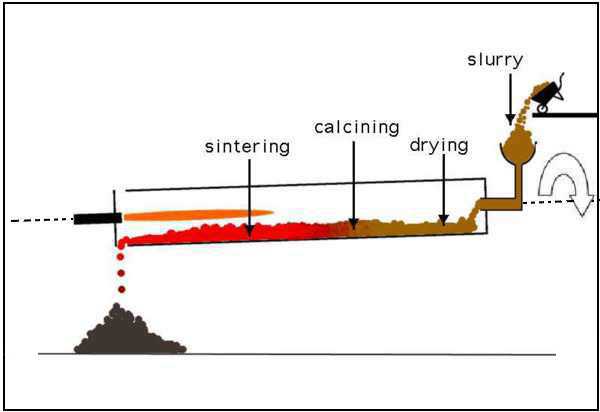


Steps:
- Crushing & Grinding of limestone + clay
- Proportioning & Mixing
- Preheating
- Burning in Rotary Kiln (1450°C) → Clinker formation
- Grinding clinker + gypsum
- Storage & Packing
🧠 Mnemonic: C-M-P-P-B-G-P
1.4 Types of Cement (JE Syllabus Based)
| Type | Special Property |
| OPC (33/43/53) | General use |
| PPC | Low heat, durable |
| Rapid Hardening Cement | Early strength |
| Low Heat Cement | Mass concrete |
| Sulphate Resisting Cement | Marine works |
| White Cement | Architectural |
1.5 Tests on Cement
Field Tests
- Color → Uniform grey
• Touch → Smooth
• Float test → Should sink
• Hand insertion → Cool feeling
Laboratory Tests
| Test | IS Code | Purpose |
| Fineness | IS 4031 | Particle size |
| Standard Consistency | IS 4031 | Water % |
| Setting Time | IS 4031 | Initial & Final |
| Soundness | IS 4031 | Volume stability |
| Compressive Strength | IS 4031 | Strength |
🔹 2. Important Formulas (Most Repeated)
Standard Consistency
Compressive Strength
📌 JE Repeated Unit: N/mm²
🧠 Short Trick:
👉 Strength = Load ÷ Area
🔹 3. Short Notes / One-Liners
- Initial setting time of OPC ≥ 30 min
• Final setting time ≤ 600 min (10 hrs)
• Soundness test → Le-Chatelier / Autoclave
• Higher C₃A → Faster setting
• Finer cement → Higher strength
• Excess gypsum → Delayed setting
🔹 4. PYQ Patterns (SSC / RRB JE)
✅ Most Asked Areas
• Compound responsible for early strength
• Temperature of kiln
• Standard consistency range (26–33%)
• Setting time limits
• OPC grades comparison
⚠️ Traps
• Confusing C₃S & C₂S
• Unit mismatch in strength
• Gypsum % error
🔹 5. Solved Examples
Numerical
A cement cube (70.6 mm) fails at 200 kN. Find strength.
✅ Answer: 40 N/mm²
Conceptual
Q: Which compound causes flash setting?
Ans: C₃A (Without gypsum)
🔹 6. MCQs (Exam Level – 30 Questions)
- Early strength of cement is due to:
A) C₂S B) C₃S C) C₄AF D) Gypsum
✅ Ans: B – C₃S hydrates fast - Gypsum is added to:
A) Increase strength
B) Control setting
C) Reduce heat
D) Improve color
✅ Ans: B – Prevents flash set - Kiln temperature is:
A) 900°C B) 1200°C C) 1450°C D) 1600°C
✅ Ans: C - Soundness test checks:
A) Strength B) Fineness C) Setting D) Volume stability
✅ Ans: D - The compound responsible for long-term strength in cement is:
- A) C₃S
B) C₃A
C) C₂S
D) C₄AF
✅ Ans: C
📝 C₂S hydrates slowly and contributes to strength after 7 days. - Standard consistency of cement generally lies between:
- A) 15–20%
B) 26–33%
C) 35–40%
D) 40–50%
✅ Ans: B
📝 Most repeated factual question in SSC JE. - Which test determines the volume stability of cement?
- A) Fineness
B) Strength
C) Soundness
D) Consistency
✅ Ans: C
📝 Soundness ensures no excessive expansion. - Initial setting time of OPC should NOT be less than:
- A) 10 min
B) 20 min
C) 30 min
D) 45 min
✅ Ans: C
📝 IS code requirement. - Final setting time of OPC should NOT exceed:
- A) 300 min
B) 480 min
C) 600 min
D) 720 min
✅ Ans: C - Cement suitable for mass concrete works is:
- A) OPC
B) Rapid hardening
C) Low heat cement
D) White cement
✅ Ans: C
📝 Reduces thermal cracking. - Which cement has maximum C₃A content?
- A) OPC
B) PPC
C) Rapid hardening cement
D) Sulphate resisting cement
✅ Ans: C - Fineness of cement is tested by:
- A) Vicat apparatus
B) Le-Chatelier
C) Compression testing machine
D) Sieve / Blaine method
✅ Ans: D - The purpose of adding gypsum to cement is to:
- A) Increase strength
B) Improve color
C) Reduce heat
D) Control setting time
✅ Ans: D - Which cement is best for marine structures?
- A) OPC
B) PPC
C) Sulphate resisting cement
D) White cement
✅ Ans: C - Soundness test is conducted using:
- A) Vicat apparatus
B) Le-Chatelier apparatus
C) Blaine apparatus
D) Compression machine
✅ Ans: B - Cement becomes hard due to:
- A) Evaporation
B) Oxidation
C) Hydration
D) Carbonation
✅ Ans: C - Heat of hydration is maximum for:
- A) C₂S
B) C₄AF
C) C₃A
D) Gypsum
✅ Ans: C - Which of the following increases early strength?
- A) Higher C₂S
B) Coarser cement
C) Higher fineness
D) Excess gypsum
✅ Ans: C - OPC 53 grade cement achieves compressive strength of 53 MPa at:
- A) 3 days
B) 7 days
C) 28 days
D) 90 days
✅ Ans: C - The standard size of cement cube for strength test is:
- A) 100 mm
B) 6 mm
C) 150 mm
D) 50 mm
✅ Ans: B - Which test determines the amount of water required for hydration?
- A) Setting time
B) Strength test
C) Soundness
D) Consistency test
✅ Ans: D - Which cement is used for architectural finishes?
- A) PPC
B) OPC
C) White cement
D) Rapid hardening
✅ Ans: C - Increase in fineness of cement results in:
- A) Lower strength
B) Higher early strength
C) Delayed setting
D) Less heat of hydration
✅ Ans: B - Which is NOT a field test of cement?
- A) Color test
B) Float test
C) Hand insertion test
D) Soundness test
✅ Ans: D
📝 Soundness is a lab test. - The chemical formula of gypsum is:
- A) CaO
B) CaCO₃
C) CaSO₄·2H₂O
D) Ca(OH)₂
✅ Ans: C - Rapid hardening cement gains strength equivalent to OPC at:
- A) 1 day
B) 3 days
C) 7 days
D) 28 days
✅ Ans: B - Which statement is TRUE?
- A) C₂S gives early strength
B) C₃S gives early strength
C) C₄AF causes flash set
D) Gypsum increases strength
✅ Ans: B - If cement shows excessive expansion, it indicates:
- A) Proper hydration
B) Unsound cement
C) Low fineness
D) Excess water
✅ Ans: B - Match the following:
- C₃S → ( )
- C₂S → ( )
- C₃A → ( )
- a) Flash setting
b) Long-term strength
c) Early strength
Correct Match:
1–c, 2–b, 3–a
✅ Ans: Correct
- A cement cube of area 5000 mm² fails at 250 kN. Strength is:
- A) 40 MPa
B) 50 MPa
C) 60 MPa
D) 25 MPa
✅ Ans: B