

🧱 Building Materials – CONCRETE (JE Exam Focused)


1️⃣ INGREDIENTS OF CONCRETE (Exam-Focused Concepts)
Concrete is an artificial composite material made by mixing cement, fine aggregate, coarse aggregate, water, and sometimes admixtures.
Key Ingredients
- Cement: Binding material (Ordinary Portland Cement most common)
- Fine Aggregate: Sand (< 4.75 mm)
- Coarse Aggregate: Gravel/stone (> 4.75 mm)
- Water: Hydration + workability
- Admixtures: Modify properties
🔑 JE Note:
👉 Water–cement ratio governs strength, not cement quantity.
2️⃣ PROPERTIES OF CONCRETE
(A) Fresh Concrete
- Workability: Ease of mixing & placing
Measured by Slump Test - Segregation: Separation of aggregates (undesirable)
- Bleeding: Water rising on surface
(B) Hardened Concrete
- Strength
- Durability
- Impermeability
🔑 Revision Highlight:
👉 High workability ≠ High strength
3️⃣ STRENGTH OF CONCRETE (Very Important)
Types of Strength
- Compressive Strength ⭐ (Most Important)
- Tensile Strength ≈ 10% of compressive
- Flexural Strength ≈ 15% of compressive
Standard Test
- Cube Size = 150 mm × 150 mm × 150 mm
- Test Age = 28 days
⭐ MOST REPEATED FORMULA
$$f_c = \frac{P}{A}$$
Where:
= compressive strength (N/mm²)
= load at failure (N)
= loaded area (mm²)
🧠 Short Trick:
👉 “28-150-Cube” → 28 days, 150 mm cube
4️⃣ CURING OF CONCRETE
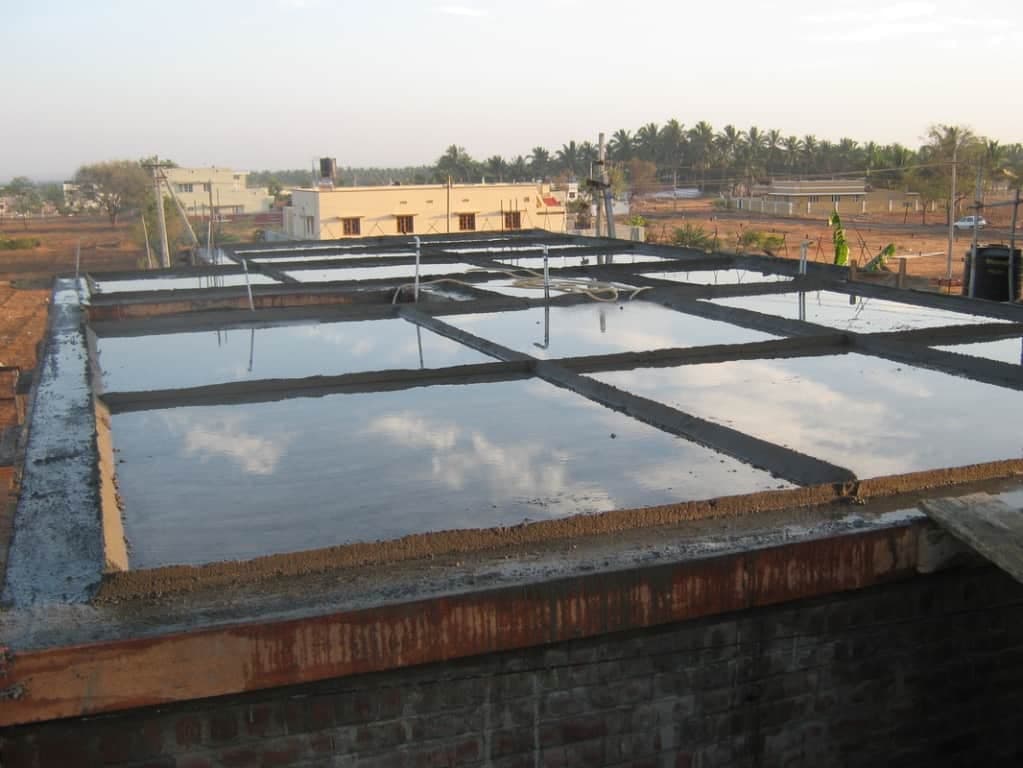
Curing = maintaining moisture & temperature for hydration.
Methods
- Water curing (ponding, sprinkling) ⭐
- Membrane curing
- Steam curing (Precast works)
⏱️ Minimum Curing Period
- OPC: 7 days
- Blended cement: 10 days
🔑 JE Question Trend:
👉 Inadequate curing reduces strength up to 40%.
5️⃣ ADMIXTURES (High-Scoring Area)
Admixtures are added (<5%) to modify concrete properties.
Types
- Accelerators: Increase early strength
- Retarders: Delay setting
- Plasticizers: Improve workability
- Superplasticizers: High strength concrete ⭐
🧠 Mnemonic:
👉 A-R-P-S → Accelerator, Retarder, Plasticizer, Superplasticizer
✍️ IMPORTANT ONE-LINERS (Last Day Revision)
- Water cement ratio law given by Abram
- Excess water ↓ strength ↑ workability
- Rich mix → more cement
- Lean mix → less cement
- Bleeding causes weak surface layer
- Steam curing gives early strength
📊 PYQ PATTERNS (SSC JE / RRB JE / OSSC JE)
✔ Repeated Topics:
- Water–cement ratio
- 28-day strength
- Slump test purpose
- Types of admixtures
⚠️ Numerical Traps:
- Wrong cube area
- Confusing N/mm² with kg/cm²
- Assuming strength ∝ cement quantity
🧮 SOLVED EXAMPLE (JE Level)
Q: A 150 mm cube fails at 450 kN. Find compressive strength.
Solution:
Area =
Load =
✅ Answer: 20 MPa
📝 MCQs – Concrete (30 Exam-Level Questions)
Q1. Strength of concrete mainly depends on?
A. Cement content
B. Aggregate size
C. Water-cement ratio ✅
D. Mixing method
📝 Lower w/c ratio → higher strength
Q2. Standard age of testing concrete cube is:
A. 7 days
B. 14 days
C. 21 days
D. 28 days ✅
📝 Characteristic strength is 28-day strength
Q3. Bleeding occurs due to:
A. Excess cement
B. Excess water ✅
C. Fine sand
D. Air entrainment
📝 Water rises to surface
Q4. The workability of concrete is directly proportional to: A. Time of transit
B. Water-cement ratio ✅
C. Grading of aggregate
D. Aggregate-cement ratio
Note: Higher water content increases fluidity, thus increasing workability.
Q5. Segregation is responsible for: A. Honeycombed concrete ✅
B. Porous layers
C. Surface scaling
D. All of the above
Note: Segregation occurs when coarse aggregates separate from the matrix, leading to voids called “Honeycombing.”
Q6. The slump test is not suitable for concrete having: A. Very high workability
B. Very low workability ✅
C. Medium workability
D. Normal workability
Note: For very dry mixes (zero slump), the Vee-Bee Consistometer test is preferred.
Q7. As per IS 456:2000, the modulus of elasticity of concrete ($E_c$) can be assumed as: A. $5000 \sqrt{f_{ck}}$ ✅
B. $5700 \sqrt{f_{ck}}$
C. $0.7 \sqrt{f_{ck}}$
D. $1000 \sqrt{f_{ck}}$
Note: This is the short-term static modulus of elasticity in $N/mm^2$.
Q8. The target mean strength ($f_{cm}$) is calculated as: A. $f_{ck} + 1.65\sigma$ ✅
B. $f_{ck} – 1.65\sigma$
C. $f_{ck} + 0.825\sigma$
D. $1.5 f_{ck}$
Note: $\sigma$ is the standard deviation. This ensures 95% of test results fall above the characteristic strength.
Q9. Addition of sugar in concrete acts as a: A. Accelerator
B. Retarder ✅
C. Air entraining agent
D. Plasticizer
Note: Sugar delays the setting time of cement significantly.
Q10. For underwater concreting, which method is most commonly used? A. Pumping
B. Tremie Method ✅
C. Skip hoisting
D. Manual pouring
Note: A Tremie pipe prevents the cement from washing away during placement.
Q11. The compaction factor test is more accurate than the slump test for: A. High workability
/B. Low workability ✅
C. Concrete with large aggregates
D. Pavement concrete
Q12. Strength of concrete at 7 days is approximately ________ of its 28-day strength. A. 40%
B. 50%
C. 67% ✅
D. 90%
Q13. In the absence of a concrete mixer, “Hand Mixing” requires extra cement of: A. 5%
B. 10% ✅
C. 15%
D. 20%
Q14. Which admixture is used to improve the workability of concrete without increasing water? A. Calcium Chloride
B. Gypsum
C. Superplasticizers ✅
D. Fly Ash
Q15. The factor of safety for concrete in the Limit State Method is: A. 1.15
B. 1.50 ✅
C. 3.0
D. 1.0
Note: For steel, it is 1.15. Concrete has a higher factor due to field variability.
Q16. Air entrainment in concrete is used to increase: A. Strength
B. Density
C. Resistance to freezing and thawing ✅
D. Modulus of elasticity
Q17. The shape of the aggregate that provides the best workability is: A. Angular
B. Flaky
C. Rounded ✅
D. Irregular
Note: Rounded aggregates have minimum surface area and less internal friction.
Q18. The process of hardening of concrete in the presence of water is called: A. Carbonation
B. Hydration ✅
C. Oxidation
D. Evaporation
Q19. For a M20 grade concrete, the ratio of ingredients (Cement:Sand:Aggregate) is: A. 1:2:4
B. 1:1.5:3 ✅
C. 1:3:6
D. 1:1:2
Q20. Crazing in concrete is caused by: A. Excess vibration
B. Rapid drying of the surface ✅
C. High water-cement ratio
D. Use of admixtures
Q21. The split tensile strength of concrete ($f_{cr}$) as per IS 456 is: A. $0.7 \sqrt{f_{ck}}$ ✅
B. $0.45 \sqrt{f_{ck}}$
C. $0.67 f_{ck}$
D. $0.5 \sqrt{f_{ck}}$
Q22. Non-Destructive Testing (NDT) of concrete is done using: A. Vicat Apparatus
B. Rebound Hammer ✅
C. Slump Cone
D. Le-Chatelier Apparatus
Q23. Which property of concrete is tested using the “Autoclave Test”? A. Strength
B. Soundness due to Magnesia ✅
C. Setting time
D. Durability
Q24. In cold weather concreting, which accelerator is most common? A. Gypsum
B. Calcium Chloride ($CaCl_2$) ✅
C. Retarder
D. Air-entraining agent
Q25. “Creep” in concrete is a: A. Instantaneous deformation
B. Time-dependent deformation ✅
C. Thermal expansion
D. Shrinkage effect
Q26. Which grade of concrete is recommended for RCC work in moderate exposure? A. M15
B. M20
C. M25 ✅
D. M30
Q27. The ratio of tensile strength to compressive strength of concrete is approximately: A. 0.05
B. 0.10 ✅
C. 0.25
D. 0.50
Q28. “Workability” is measured using a Slump Cone of height: A. 15 cm
B. 20 cm
C. 30 cm ✅
D. 45 cm
Q29. For mass concreting (like dams), we use: A. Rapid Hardening Cement
B. Low Heat Cement ✅
C. Quick Setting Cement
D. High Alumina Cement
Q30. Characteristic strength is defined as that strength below which not more than _____ % of results are expected to fall. A. 2%
B. 5% ✅
C. 10%
D. 15%