

SOIL MECHANICS – CHAPTER 2
SOIL PHASE SYSTEM (3-PHASE SYSTEM)
(SSC JE | RRB JE | OSSC JE – VERY IMPORTANT & SCORING)


🔹 1. ONE-PAGE PRECISE ONE-LINER NOTES (EXAM FOCUSED)
🔸 Soil Phase System
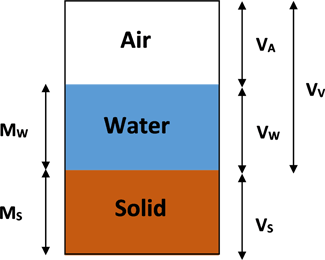
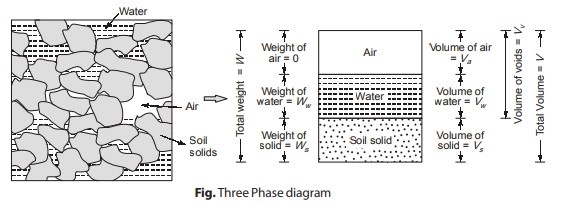
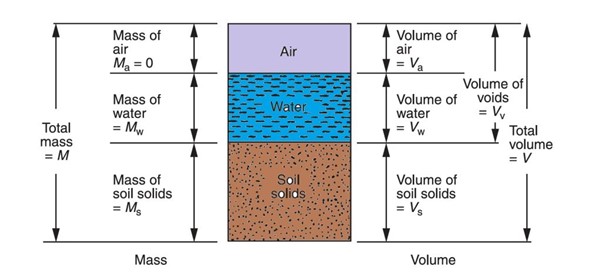
Soil consists of:
- Solid phase (soil particles)
- Liquid phase (water)
- Gaseous phase (air)
🔸 Types of Soil System
| Soil Condition | Phases Present |
| Dry soil | Solids + Air |
| Partially saturated soil | Solids + Water + Air |
| Fully saturated soil | Solids + Water |
| Submerged soil | Solids + Water (below water table) |
📌 Most practical soils → Partially saturated
🔸 Volume Relations
| Symbol | Meaning |
| Volume of solids | |
| Volume of water | |
| Volume of air | |
| Volume of voids | |
| Total volume |
🔸 Weight Relations
| Symbol | Meaning |
| Weight of solids | |
| Weight of water | |
| Weight of air (≈ 0) | |
| Total weight |
🔹 2. IMPORTANT SOIL PHASE RELATIONS (VERY IMPORTANT)
🔸 Water Content
🔸 Void Ratio
📌 Range: 0.3 to 1.2 (usually)
🔸 Porosity
📌 Relation between n & e:
🔸 Degree of Saturation
📌 Dry soil →
📌 Fully saturated soil →
🔸 Air Content
🔸 Percentage Air Voids
🔸 Specific Gravity
🔸 Unit Weights
| Type | Formula |
| Bulk | |
| Dry | |
| Saturated | |
| Submerged |
🔹 3. KEY EXAM TABLES
🔸 Important Relationships
| Relation | Formula |
| Void ratio–porosity | |
| Porosity–void ratio | |
| Dry unit weight | |
| Saturated unit weight |
🔹 4. IMPORTANT NUMERICAL EXAMPLES (4–6)
🔢 Example 1 (Easy – Void Ratio)
Given:
,
🔢 Example 2 (Moderate – Porosity)
Given:
🔢 Example 3 (Moderate – Degree of Saturation)
Given:
,
🔢 Example 4 (Advanced – Dry Unit Weight)
Given:
Bulk unit weight
Water content
🔢 Example 5 (Advanced – Saturated Unit Weight)
Given:
, ,
🔹 5. 50 EXAM-LEVEL MCQs
(25 THEORY + 25 NUMERICAL)
🟢 THEORY MCQs (1–25)
Q1. A partially saturated soil consists of:
- Solids only
B. Solids + water
C. Solids + air
D. Solids + water + air ✅
Q2. Which parameter is always less than unity?
- Void ratio
B. Porosity ✅
C. Water content
D. Unit weight
Q3. Degree of saturation of dry soil is:
- 0 ✅
B. 0.5
C. 1
D. Cannot be defined
Q4. Which quantity has no unit?
- Unit weight
B. Density
C. Specific gravity ✅
D. Water content
Q5. Volume of voids consists of:
- Solids only
B. Water only
C. Air only
D. Water + Air ✅
Q6. Soil is defined as a three-phase system consisting of:
- A) Solids, water, air
B) Solids, voids, water
C) Solids, air, minerals
D) Water, air, minerals
Answer: A
Q7. Void ratio (e) is defined as the ratio of:
- A) Volume of voids to total volume
B) Volume of solids to volume of voids
C) Volume of voids to volume of solids
D) Total volume to volume of solids
Answer: C
Q8. The relationship between porosity (n) and void ratio (e) is:
- A)
B)
C)
D)
Answer: B
Q9. For a given soil mass, if void ratio decreases, the porosity will:
- A) Increase
B) Decrease
C) Remain constant
D) Become zero
Answer: B
Q10. Degree of saturation is defined as the ratio of:
- A) Volume of water to total volume
B) Volume of water to volume of solids
C) Volume of water to volume of voids
D) Volume of voids to volume of water
Answer: C
Q11. Degree of saturation of a completely dry soil is:
- A) 0%
B) 50%
C) 100%
D) Cannot be defined
Answer: A
Q12. Degree of saturation of a fully saturated soil is:
- A) 0
B) 0.5
C) 1
D) Greater than 1
Answer: C
Q13. Water content of soil is defined as the ratio of:
- A) Weight of water to total weight
B) Weight of water to weight of solids
C) Weight of solids to weight of water
D) Volume of water to volume of solids
Answer: B
Q14. Which of the following parameters is dimensionless?
- A) Water content
B) Unit weight
C) Density
D) Specific weight
Answer: A
Q15. Specific gravity of soil solids is defined as the ratio of:
- A) Density of soil to density of water
B) Weight of soil to weight of water
C) Density of soil solids to density of water
D) Weight of solids to volume of water
Answer: C
Q16. Typical value of specific gravity of inorganic soil solids is:
- A) 1.0–1.5
B) 1.5–2.0
C) 2.6–2.8
D) 3.5–4.0
Answer: C
Q17. Bulk unit weight of soil is the weight of:
- A) Solids only per unit volume
B) Water only per unit volume
C) Solids and water per unit total volume
D) Solids and air per unit volume
Answer: C
Q18. Saturated unit weight of soil is maximum when soil is:
- A) Dry
B) Partially saturated
C) Fully saturated
D) Fully dry and compacted
Answer: C
Q19. Which condition results in zero air voids?
- A) Dry soil
B) Partially saturated soil
C) Fully saturated soil
D) Loose soil
Answer: C
Q20. Air content of a saturated soil is:
- A) Zero
B) One
C) Equal to porosity
D) Equal to void ratio
Answer: A
Q21. If degree of saturation increases, water content will:
- A) Decrease
B) Increase
C) Remain constant
D) Become zero
Answer: B
Q22. Which of the following is not possible for natural soils?
- A) Void ratio = 0.3
B) Degree of saturation = 1
C) Porosity = 0.8
D) Degree of saturation > 1
Answer: D
Q23. For a given soil, specific gravity of solids depends mainly on:
- A) Void ratio
B) Water content
C) Mineral composition
D) Degree of saturation
Answer: C
Q24. If water content is zero, the soil is said to be:
- A) Saturated
B) Partially saturated
C) Dry
D) Cohesionless
Answer: C
Q25. Which parameter remains unchanged during compaction?
- A) Void ratio
B) Porosity
C) Specific gravity of solids
D) Dry density
Answer: C
🟡 NUMERICAL MCQs (26–50)
Q26. If and , void ratio is:
- 0.25
B. 0.4
C. 0.5 ✅
D. 1.0
Q27. Porosity corresponding to is:
- 25%
B. 33.3% ✅
C. 40%
D. 50%
Q28. Degree of saturation when and is:
- 20%
B. 30%
C. 40% ✅
D. 50%
Q29. Dry unit weight if bulk unit weight is 20 kN/m³ and water content is 25%:
- 14
B. 16 ✅
C. 18
D. 20
Q30. Saturated unit weight for , , is:
- 18
B. 19
C. 20 ✅
D. 22
🟡 NUMERICAL MCQs (Q31–Q50)
Q31. If porosity of soil is 0.4, the corresponding void ratio is:
- 0.25
B. 0.40
C. 0.67 ✅
D. 1.00
Solution:
Q32. A soil has void ratio 0.8. Its porosity is:
- 30%
B. 40%
C. 44.4% ✅
D. 50%
Q33. Degree of saturation of a fully saturated soil is:
- 0
B. 0.5
C. 1.0 ✅
D. Greater than 1
Q34. If volume of voids is 0.6 m³ and volume of water is 0.3 m³, degree of saturation is:
- 25%
B. 40%
C. 50% ✅
D. 75%
Q35. Volume of air in a soil sample is 0.2 m³ and volume of voids is 0.5 m³. Air content is:
- 20%
B. 30%
C. 40% ✅
D. 60%
Q36. Bulk unit weight of soil is 18 kN/m³ and water content is 20%. Dry unit weight is:
- 13
B. 15 ✅
C. 16
D. 18
Q37. If dry unit weight is 16 kN/m³ and water content is 25%, bulk unit weight is:
- 18
B. 19
C. 20 ✅
D. 22
Q38. Saturated unit weight of soil is 20 kN/m³. Unit weight of water is 10 kN/m³. Submerged unit weight is:
- 5
B. 8
C. 10 ✅
D. 20
Q39. For a dry soil, the degree of saturation is:
- 0 ✅
B. 0.5
C. 1.0
D. Cannot be determined
Q40. Void ratio of a soil having porosity 50% is:
- 0.5
B. 1.0 ✅
C. 1.5
D. 2.0
Q41. Which soil condition has zero air voids?
- Dry soil
B. Partially saturated soil
C. Fully saturated soil ✅
D. Loose soil
Q42. If , , and , saturated unit weight is:
- 17
B. 18
C. 19.4 ✅
D. 21
Q43. Percentage air voids is defined as:
-
B.
C. ✅
D.
Q44. A soil sample has , . Porosity is:
- 30%
B. 40% ✅
C. 50%
D. 60%
Q45. If void ratio of soil increases, porosity will:
- Decrease
B. Remain constant
C. Increase ✅
D. Become zero
Q46. Degree of saturation cannot be greater than:
- 0.5
B. 0.8
C. 1.0 ✅
D. 1.5
Q47. Dry unit weight of soil becomes equal to bulk unit weight when:
- Soil is saturated
B. Soil is submerged
C. Soil is completely dry ✅
D. Soil is loose
Q48. Which parameter changes with water content?
- Specific gravity
B. Volume of solids
C. Bulk unit weight ✅
D. Density of solids
Q49. If soil is submerged, the effective unit weight acting is:
- Bulk unit weight
B. Dry unit weight
C. Submerged unit weight ✅
D. Saturated unit weight
Q50. Void ratio of soil is zero when:
- Soil is saturated
B. Soil is loose
C. No voids are present ✅
D. Soil is submerged