1. CONCEPT EXPLANATION (Exam-Focused)
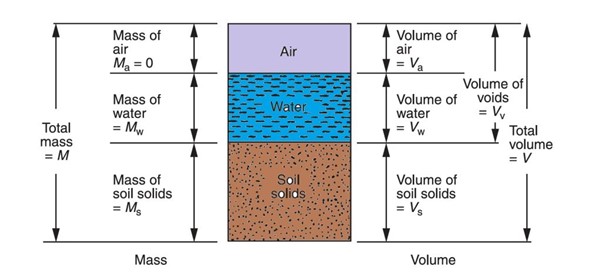
1. Water Content ($w$)
-
Ratio of weight of water to weight of solids.
-
Indicates moisture condition of soil.
$$w = \frac{W_w}{W_s}$$
2. Specific Gravity ($G$)
-
Ratio of unit weight of soil solids to water.
-
Typical range: 2.6 – 2.75
$$G = \frac{\gamma_s}{\gamma_w}$$
3. Void Ratio ($e$)
-
Ratio of volume of voids to volume of solids.
-
Important for settlement & permeability.
$$e = \frac{V_v}{V_s}$$
4. Porosity ($n$)
-
Ratio of volume of voids to total volume.
$$n = \frac{V_v}{V}$$ -
Relation between $e$ and $n$:
$$n = \frac{e}{1+e}$$
5. Degree of Saturation ($S$)
-
Percentage of voids filled with water.
$$S = \frac{V_w}{V_v}$$
6. Unit Weight
| Type | Formula |
| Bulk |
$$\gamma = \frac{W}{V}$$
|
| Dry |
$$\gamma_d = \frac{W_s}{V}$$
|
| Saturated |
$$\gamma_{sat} = \frac{W_{sat}}{V}$$
|
| Submerged |
$$\gamma’ = \gamma_{sat} – \gamma_w$$
|
7. Consistency Limits (Atterberg Limits)
-
Used for fine-grained soils.
| Limit | Meaning |
| Liquid Limit (LL) | Plastic \to Liquid state |
| Plastic Limit (PL) | Semi-solid \to Plastic state |
| Shrinkage Limit (SL) | No volume change boundary |
Indexes:
-
Plasticity Index:
$$PI = LL – PL$$ -
Liquidity Index:
$$LI = \frac{w – PL}{PI}$$
2. IMPORTANT FORMULAS (Most Repeated)
| Formula | Usage |
|
$$w = \frac{W_w}{W_s}$$
|
Water content |
|
$$e = \frac{V_v}{V_s}$$
|
Void ratio |
|
$$n = \frac{e}{1+e}$$
|
Porosity |
|
$$\gamma_d = \frac{\gamma}{1+w}$$
|
Dry unit weight |
|
$$\gamma_{sat} = \frac{(G+e)\gamma_w}{1+e}$$
|
Saturated unit weight |
|
$$S = \frac{wG}{e}$$
|
Degree of saturation (or $Se = wG$) |
|
$$PI = LL – PL$$
|
Plasticity index |
⭐ Most Important in Exams:
Void ratio relation, degree of saturation formula ($Se=wG$), and dry unit weight.
3. SHORT NOTES / ONE-LINERS
-
Coarse soils $\to$ low plasticity
-
Higher void ratio $\to$ lower strength
-
$n$ is always $< 1$, but $e$ can be $> 1$
-
For fully saturated soil $\to S = 100\%$
-
Clay soils $\to$ high $LL$ & $PI$
-
If $PI = 0 \to$ Non-plastic soil
-
Shrinkage limit is independent of moisture
4. SOLVED EXAMPLES
Example 1 (Numerical – SSC JE)
A soil has: $G = 2.7$, $e = 0.6$, $\gamma_w = 9.81 \text{ kN/m}^3$.
Find $\gamma_{sat}$.
Solution:
Example 2 (Conceptual)
Which soil shows maximum volume change?
Answer: Clay (due to high plasticity)
5. MCQs (Exam Level – 50)
Q1. Void ratio is defined as:
A) $V/V_v$
B) $V_v/V_s$
C) $V_s/V$
D) $V/V_s$
✅ Ans: B – Ratio of voids to solids.
Q2. If $e = 0.8$, find $n$.
✅ Ans: 0.44
Q3. For saturated soil, degree of saturation is:
A) 0
B) 50%
C) 100%
D) 75%
✅ Ans: C
Q4. Plasticity index represents:
A) Strength
B) Compressibility
C) Plastic range
D) Permeability
✅ Ans: C
Q5. Typical $G$ value of soil?
A) 1.5
B) 2.65
C) 4.0
D) 0.9
✅ Ans: B
Q6. If the void ratio of a soil sample is 1.0, its porosity will be:
A) 0.25
B) 0.33
C) 0.50
D) 0.75
✅ Ans: C
Q7. Which of the following soil has the highest plasticity?
A) Gravel
B) Sand
C) Silt
D) Clay
✅ Ans: D – Clay has finest particles and highest plasticity.
Q8. Degree of saturation of completely dry soil is:
A) 0
B) 25%
C) 50%
D) 100%
For dry soil, $V_w = 0$.
✅ Ans: A
Q9. Void ratio of a soil is 0.6. What is its porosity?
A) 0.375
B) 0.50
C) 0.60
D) 0.80
✅ Ans: A
Q10. Which of the following is always less than 1?
A) Void ratio
B) Porosity
C) Water content
D) Degree of saturation
✅ Ans: B – Porosity is always $< 1$.
Q11. Void ratio of soil can be:
A) Less than 1 only
B) Equal to 1 only
C) Greater than 1
D) Always less than porosity
✅ Ans: C – $e$ can exceed 1 in loose soils.
Q12. For saturated soil:
A) Air content = 0
B) Water content = 0
C) Porosity = 0
D) Void ratio = 0
✅ Ans: A
Q13. Which unit weight is maximum?
A) Dry
B) Submerged
C) Bulk
D) Saturated
✅ Ans: D
Q14. Submerged unit weight is given by:
A) $\gamma_{sat} + \gamma_w$
B) $\gamma – \gamma_w$
C) $\gamma_{sat} – \gamma_w$
D) $\gamma_d – \gamma_w$
✅ Ans: C
Q15. If PI = 0, soil is:
A) Clay
B) Silt
C) Non-plastic
D) Organic
✅ Ans: C
Q16. Plasticity index represents:
A) Moisture content
B) Strength
C) Plastic range
D) Permeability
✅ Ans: C
Q17. Which limit is determined using Casagrande apparatus?
A) PL
B) LL
C) SL
D) PI
✅ Ans: B
Q18. Shrinkage limit is the water content at which:
A) Soil becomes plastic
B) Volume change stops
C) Soil becomes liquid
D) Air voids disappear
✅ Ans: B
Q19. For fine-grained soils, consistency limits are used to:
A) Find permeability
B) Classify soil
C) Determine strength
D) Find compaction
✅ Ans: B
Q20. Which soil has maximum compressibility?
A) Gravel
B) Sand
C) Silt
D) Clay
✅ Ans: D
Q21. If water content increases, shear strength:
A) Increases
B) Decreases
C) Constant
D) Zero
✅ Ans: B
Q22. High liquid limit indicates:
A) Low compressibility
B) High compressibility
C) Low permeability
D) High density
✅ Ans: B
Q23. Which soil shows maximum permeability?
A) Clay
B) Silt
C) Sand
D) Peat
✅ Ans: C
Q24. Porosity of soil depends on:
A) Particle size only
B) Shape only
C) Packing only
D) All of the above
✅ Ans: D
Q25. For fully saturated soil, air content is:
A) 100%
B) 50%
C) 0%
D) 25%
✅ Ans: C
Q26. Which relation is correct?
A) $n = e(1+e)$
B) $e = \frac{n}{1+n}$
C) $n = \frac{e}{1+e}$
D) $e = n(1+e)$
✅ Ans: C
Q27. Dry unit weight is always:
A) Greater than bulk
B) Less than bulk
C) Equal to bulk
D) Independent
✅ Ans: B
Q28. Which test is used for plastic limit?
A) Cone penetration
B) Hydrometer
C) Rolling thread
D) Sieve analysis
✅ Ans: C
Q29. Water content is expressed in:
A) Ratio
B) Percentage
C) Decimal
D) Volume
✅ Ans: B
Q30. Which soil is most suitable for embankments?
A) Clay
B) Silt
C) Sand
D) Peat
✅ Ans: C
Q31. Degree of saturation can be:
A) More than 100%
B) Equal to 100%
C) Less than 0
D) Always 50%
✅ Ans: B
Q32. Void ratio is independent of:
A) Volume of voids
B) Volume of solids
C) Total volume
D) Particle shape
✅ Ans: C
Q33. Which soil has highest shrinkage?
A) Gravel
B) Sand
C) Silt
D) Clay
✅ Ans: D
Q34. Plasticity index is used for:
A) Soil classification
B) Compaction
C) Permeability
D) Consolidation
✅ Ans: A
Q35. Higher void ratio means:
A) Higher density
B) Lower permeability
C) Lower strength
D) Higher strength
✅ Ans: C
Q36. Which is correct order?
A) $LL < PL < SL$
B) $PL < SL < LL$
C) $SL < PL < LL$
D) $PL < LL < SL$
✅ Ans: C
Q37. In organic soils, liquid limit is:
A) Low
B) Medium
C) High
D) Zero
✅ Ans: C
Q38. If soil is fully saturated:
A) $e = 0$
B) $n = 0$
C) $S = 100\%$
D) $w = 0$
✅ Ans: C
Q39. Which soil is least permeable?
A) Gravel
B) Sand
C) Silt
D) Clay
✅ Ans: D
Q40. Bulk unit weight includes:
A) Only solids
B) Solids + water
C) Solids + air
D) Only voids
✅ Ans: B
Q41. Which parameter is dimensionless?
A) Unit weight
B) Void ratio
C) Volume
D) Weight
✅ Ans: B
Q42. Plastic limit is found by:
A) Cone test
B) Casagrande cup
C) Rolling thread method
D) Pycnometer
✅ Ans: C
Q43. Which soil has highest specific surface area?
A) Gravel
B) Sand
C) Silt
D) Clay
✅ Ans: D
Q44. Increase in porosity leads to:
A) Increase in strength
B) Decrease in permeability
C) Decrease in density
D) No change
✅ Ans: C
Q45. Shrinkage limit depends on:
A) Moisture content
B) Grain size
C) Mineralogy
D) Both B & C
✅ Ans: D
Q46. Which of the following is NOT a consistency limit?
A) Liquid limit
B) Plastic limit
C) Shrinkage limit
D) Flow limit
✅ Ans: D
Q47. Which index indicates relative consistency?
A) PI
B) LI
C) SI
D) CI
✅ Ans: B
Q48. For cohesionless soil, PI is:
A) High
B) Medium
C) Zero
D) Negative
✅ Ans: C
Q49. Which soil shows maximum capillarity?
A) Gravel
B) Sand
C) Silt
D) Clay
✅ Ans: D
Q50. Which parameter is used to indicate volume change?
A) Water content
B) Void ratio
C) Degree of saturation
D) Unit weight
✅ Ans: B
About the Author