SOIL MECHANICS – CHAPTER 1
ORIGIN OF SOIL
(SSC JE | RRB JE | OSSC JE – HIGH WEIGHTAGE)
🔹 1. ONE-PAGE PRECISE ONE-LINER NOTES (EXAM FOCUSED)
🔸 Definition
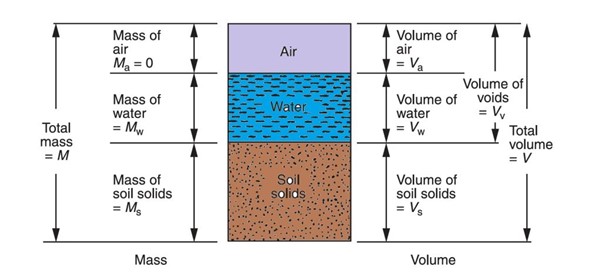
- Soil: Unconsolidated material formed by disintegration and decomposition of rocks, containing solid particles, water, and air.
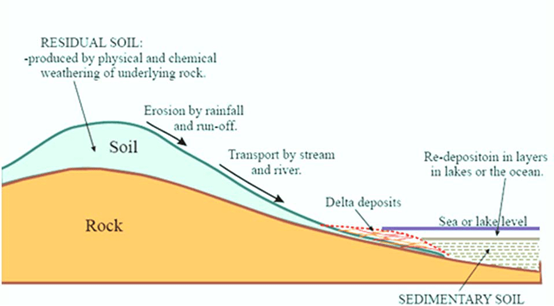
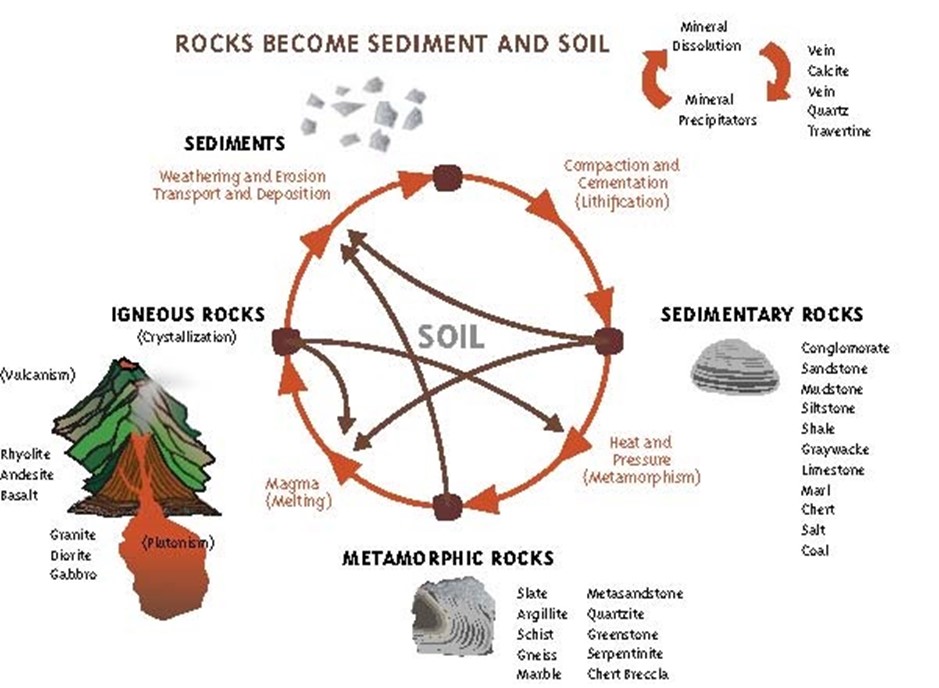
🔸 Geological Cycle of Soil Formation
Rock → Weathering → Transportation → Deposition → Soil
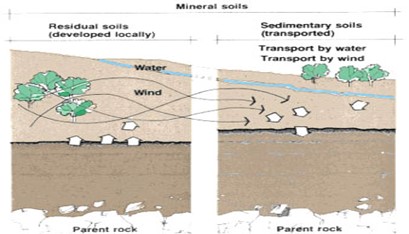
🔸 Classification Based on Origin
| Type | Description |
| Residual Soil | Formed at the place of parent rock |
| Transported Soil | Carried and deposited by natural agencies |
🔸 Residual Soil
- Formed in-situ
- Parent rock lies just below soil
- High bearing capacity
- Low compressibility
- Generally angular particles
- Example: Laterite soil
🔸 Transported Soil ⭐ (MOST EXAM QUESTIONS)
| Agency | Soil Type | Characteristics |
| Water | Alluvial | Rounded particles, fertile |
| Wind | Aeolian | Fine, uniform, loose |
| Ice | Glacial | Angular, poorly graded |
| Gravity | Colluvial | Coarse, unstable |
| Sea | Marine | High salt content |
| Lake | Lacustrine | Fine silt and clay |
📌 Most fertile soil → Alluvial
📌 Least stable soil → Colluvial
🔸 Weathering of Rocks
| Type | Key Point |
| Physical | No chemical change |
| Chemical | Chemical composition changes |
| Biological | Action of plants & organisms |
🔸 Physical Weathering ⭐⭐ (MOST IMPORTANT)
- Temperature variation
- Frost action
- Abrasion
- Exfoliation
🔸 Chemical Weathering
- Oxidation
- Hydration
- Carbonation
- Solution
🔸 Biological Weathering
- Root pressure
- Micro-organisms
- Burrowing animals
🔸 Soil Profile ⭐ (1-Mark MCQs)
| Horizon | Description |
| O | Organic matter |
| A | Top soil |
| B | Sub soil |
| C | Weathered rock |
| R | Parent rock |
🔸 Important Exam Comparisons
| Residual Soil | Transported Soil |
| In-situ | Deposited elsewhere |
| Angular grains | Rounded grains |
| Dense | Loose |
| High SBC | Lower SBC |
🔹 2. IMPORTANT FORMULAS (WITH SYMBOLS & UNITS)
⚠️ Origin of soil has limited numericals, but basic soil parameters are often linked.
🔸 Unit Weight

🔸 Density

🔸 Specific Gravity

🔸 Water Content

🔹 3. KEY TABLES (VERY IMPORTANT)
🔸 Transported Soil vs Agency (DIRECT MCQs)
| Soil | Transport Medium |
| Alluvial | River |
| Aeolian | Wind |
| Glacial | Ice |
| Colluvial | Gravity |
| Marine | Sea |
| Lacustrine | Lake |
🔸 Shape of Soil Particles
| Soil | Shape |
| Residual | Angular |
| Alluvial | Rounded |
| Aeolian | Sub-rounded |
| Glacial | Angular |
🔹 4. IMPORTANT NUMERICAL EXAMPLES (4–6)
🔢 Example 1 (Easy)
Given:
Weight
Volume

✅ Answer: 15 kN/m³
🔢 Example 2 (Moderate)
Given:
Mass
Volume

🔢 Example 3 (Moderate)
Given:
Dry soil weight
Water weight

🔢 Example 4 (Advanced)
Given:
Specific gravity

🔢 Example 5 (Conceptual)
Question: Soil transported by glacier is called?
✅ Answer: Glacial soil
🔹 5. 50 EXAM-LEVEL MCQs
(25 THEORY + 25 NUMERICAL)
🟢 THEORY MCQs (1–25)
Q1. Soil formed at the place of parent rock is called:
- Alluvial
B. Aeolian
C. Residual ✅
D. Marine
Explanation: Residual soil is formed in-situ.
❌ Others are transported soils.
Q2. Which agent produces rounded soil particles?
- Wind
B. Ice
C. Water ✅
D. Gravity
Tip: Water causes maximum abrasion.
Q3. Aeolian soil is transported by:
- Water
B. Ice
C. Wind ✅
D. Gravity
Q4. Which soil has highest bearing capacity?
- Marine
B. Aeolian
C. Residual ✅
D. Alluvial
Q5. Chemical weathering includes:
- Abrasion
B. Oxidation ✅
C. Frost action
D. Exfoliation
Q6. The topmost layer of soil rich in organic matter is called:
- A) Horizon B
B) Horizon C
C) Horizon A
D) Horizon D
Answer: C
Q7. Which soil horizon is known as the zone of accumulation (illuviation)?
- A) O-horizon
B) A-horizon
C) B-horizon
D) C-horizon
Answer: C
Q8. The process by which soil particles are removed from the upper horizon and deposited in lower horizon is called:
- A) Eluviation
B) Illuviation
C) Leaching
D) Weathering
Answer: B
Q9. Which of the following is not an agent of weathering?
- A) Wind
B) Water
C) Temperature
D) Cement
Answer: D
Q10. Mechanical weathering mainly results in:
- A) Chemical decomposition
B) Increase in particle size
C) Decrease in particle size
D) Formation of new minerals
Answer: C
Q11. Chemical weathering of feldspar produces mainly:
- A) Quartz
B) Mica
C) Kaolinite
D) Calcite
Answer: C
Q12. Which type of weathering is dominant in hot and humid climates?
- A) Physical weathering
B) Chemical weathering
C) Biological weathering
D) Frost weathering
Answer: B
Q13. Laterite soil is formed due to:
- A) Mechanical weathering
B) Chemical weathering with leaching
C) Frost action
D) Volcanic activity
Answer: B
Q14. The soil horizon consisting of partially weathered parent rock is:
- A) A-horizon
B) B-horizon
C) C-horizon
D) O-horizon
Answer: C
Q15. Residual soil is:
- A) Transported by wind
B) Transported by water
C) Formed in place
D) Deposited by glacier
Answer: C
Q16. Which of the following is an example of transported soil?
- A) Black cotton soil
B) Laterite soil
C) Alluvial soil
D) Residual soil
Answer: C
Q17. The process of breaking down rocks by plant roots is called:
- A) Mechanical weathering
B) Chemical weathering
C) Biological weathering
D) Thermal weathering
Answer: C
Q18. Exfoliation is associated with:
- A) Frost action
B) Chemical weathering
C) Thermal expansion
D) Oxidation
Answer: C
Q19. Which soil has the highest permeability?
- A) Clay
B) Silt
C) Sand
D) Loam
Answer: C
Q20. Which soil has the highest capillarity?
- A) Gravel
B) Sand
C) Silt
D) Clay
Answer: D
Q21. Humus mainly improves soil:
- A) Density
B) Strength
C) Fertility
D) Plasticity
Answer: C
Q22. Which of the following has the lowest bearing capacity?
- A) Gravel
B) Sand
C) Silt
D) Clay
Answer: D
Q23. Weathering differs from erosion because weathering:
- A) Involves transportation
B) Forms sediments
C) Acts in situ
D) Is caused only by wind
Answer: C
Q24. The disintegration of rocks without chemical change is called:
- A) Chemical weathering
B) Physical weathering
C) Biological weathering
D) Oxidation
Answer: B
Q25. Which of the following is not a product of chemical weathering?
- A) Kaolinite
B) Laterite
C) Bauxite
D) Gravel
Answer: D
🟡 NUMERICAL MCQs (26–50)
Q26. Weight = 20 kN, Volume = 2 m³. Unit weight?
- 8
B. 10 ✅
C. 12
D. 15

Q27. Specific gravity = 2.7. Density of soil solids?
- 1700
B. 2000
C. 2700 ✅
D. 3000
Q28. Water content = 25%, dry weight = 400 N. Water weight?

🟡 NUMERICAL MCQs (Q29–Q50)
Q29. The unit weight of soil having weight 16 kN and volume 2 m³ is:
- 6 kN/m³
B. 8 kN/m³ ✅
C. 10 kN/m³
D. 12 kN/m³
Solution:

Q30. If the mass of soil is 2400 kg and volume is 2 m³, the density is:
- 1000 kg/m³
1200 kg/m³ ✅
C. 1800 kg/m³
D. 2400 kg/m³

Q31. Specific gravity of soil solids is 2.6. Density of soil solids is:
- 2000 kg/m³
2400 kg/m³
C. 2600 kg/m³ ✅
D. 3000 kg/m³

Q32. A soil sample weighs 10 kN and occupies 0.5 m³. Its unit weight is:
- 10 kN/m³
B. 15 kN/m³
C. 20 kN/m³ ✅
D. 25 kN/m³

Q33. Dry weight of soil is 500 N and water content is 20%. Weight of water is:
- 50 N
B. 80 N
C. 100 N ✅
D. 120 N

Q34. If total mass of wet soil is 2200 kg and dry mass is 2000 kg, water content is:
- 8%
B. 10% ✅
C. 12%
D. 15%

Q35. Density of water is taken as:
- 9.81 kN/m³
B. 1 g/cm³
C. 1000 kg/m³
D. All of the above ✅
Explanation:
All values represent density/unit weight in different units.
Q36. Unit weight of soil increases when:
- Water content decreases
B. Void ratio increases
C. Density increases ✅
D. Air content increases
Tip: Higher density → higher unit weight
Q37. The ratio of density of soil solids to density of water is called:
- Unit weight
B. Density index
C. Specific gravity ✅
D. Porosity
Q38. A soil has volume 1 m³ and mass 1800 kg. Its unit weight (g = 10 m/s²) is:
- 16 kN/m³
B. 17 kN/m³
C. 18 kN/m³ ✅
D. 20 kN/m³

Q39. Water content of a completely dry soil is:
- 0% ✅
B. 5%
C. 10%
D. Cannot be zero
Q40. If specific gravity of soil is 2.7, then:
- Soil is organic
B. Soil solids are lighter than water
C. Soil solids are heavier than water ✅
D. Soil is saturated
Q41. Which soil parameter is dimensionless?
- Density
B. Unit weight
C. Specific gravity ✅
D. Water content
Q42. The SI unit of density is:
- g/cm³
B. kg/m³ ✅
C. kN/m³
D. N/m²
Q43. Unit weight of water is approximately:
- 9.81 kN/m³ ✅
B. 10 kN/m²
C. 1000 kg/m³
D. 1 g/cm³
Q44. Water content is defined as:
-
B. ✅
C.
D.
Q45. Which of the following depends on gravity?
- Density
B. Specific gravity
C. Unit weight ✅
D. Water content
Q46. If the volume of soil increases with same weight, unit weight will:
- Increase
B. Decrease ✅
C. Remain same
D. Become zero
Q47. Typical value of specific gravity of inorganic soil solids ranges between:
- 1.0 – 1.5
B. 1.5 – 2.0
C. 2.5 – 2.8 ✅
D. 3.0 – 3.5
Q48. Density multiplied by acceleration due to gravity gives:
- Specific gravity
B. Unit weight ✅
C. Water content
D. Porosity
Q49. A soil sample has zero water content when:
- Fully saturated
B. Partially saturated
C. Completely dry ✅
D. Fully submerged
Q50. Which property is used to compare heaviness of soil solids with water?
- Density
B. Unit weight
C. Specific gravity ✅
D. Water content
🔥 QUICK REVISION TRICKS (EXAM GOLD)
Unit weight = Weight / Volume
Density = Mass / Volume
Specific gravity has NO unit
ρsoil = G × ρwater
Water content always based on dry weight
About the Author