Introduction
Bricks are one of the oldest and most widely used building materials in construction. They are strong, durable, affordable, and easy to use. From houses and schools to bridges and commercial buildings, bricks play an important role in modern construction.
A brick is usually made from clay and is molded into a rectangular shape before being dried and burned in a kiln. Due to their strength and long life, bricks are highly preferred for walls, foundations, pavements, and many other construction works.
In this article, you will learn about bricks, their types, properties, manufacturing process, advantages, disadvantages, and uses in simple and easy English.
What Are Bricks?
Bricks are small rectangular blocks used as a basic construction material. They are generally made from:
- Clay
- Sand
- Lime
- Concrete
- Fly ash
Bricks are joined together using mortar to construct walls and other structural elements.
Types of Bricks
Different types of bricks are used for different construction purposes.
1. Burnt Clay Bricks
These are the most common bricks used in construction.
Types of Burnt Clay Bricks
| Type | Description |
| First Class Bricks | High-quality bricks with smooth finish |
| Second Class Bricks | Slightly irregular shape and surface |
| Third Class Bricks | Low-quality bricks used for temporary structures |
| Fourth Class Bricks | Over-burnt bricks used as aggregates |
2. Fly Ash Bricks
Fly ash bricks are made from fly ash, cement, and sand.
Advantages
- Lightweight
- Eco-friendly
- Smooth finish
- High strength
Uses
- Residential buildings
- Commercial structures
- Partition walls
3. Concrete Bricks
Concrete bricks are manufactured using cement and aggregates.
Features
- Strong and durable
- Available in different sizes
- Used for facades and fences
4. Sand Lime Bricks
These bricks are made using sand and lime under pressure.
Properties
- Uniform shape
- Smooth surface
- Good strength
5. Fire Bricks
Fire bricks can resist very high temperatures.
Uses
- Furnaces
- Fireplaces
- Kilns
Standard Size of Bricks
The standard brick size may vary by country.
| Type | Size |
| Modular Brick | 190 mm × 90 mm × 90 mm |
| Non-Modular Brick | 230 mm × 110 mm × 70 mm |
Properties of Good Bricks
A good brick should have the following properties:
- Uniform shape and size
- Bright red color
- Hard and durable
- Free from cracks
- Low water absorption
- Good compressive strength
- Clear ringing sound when struck together
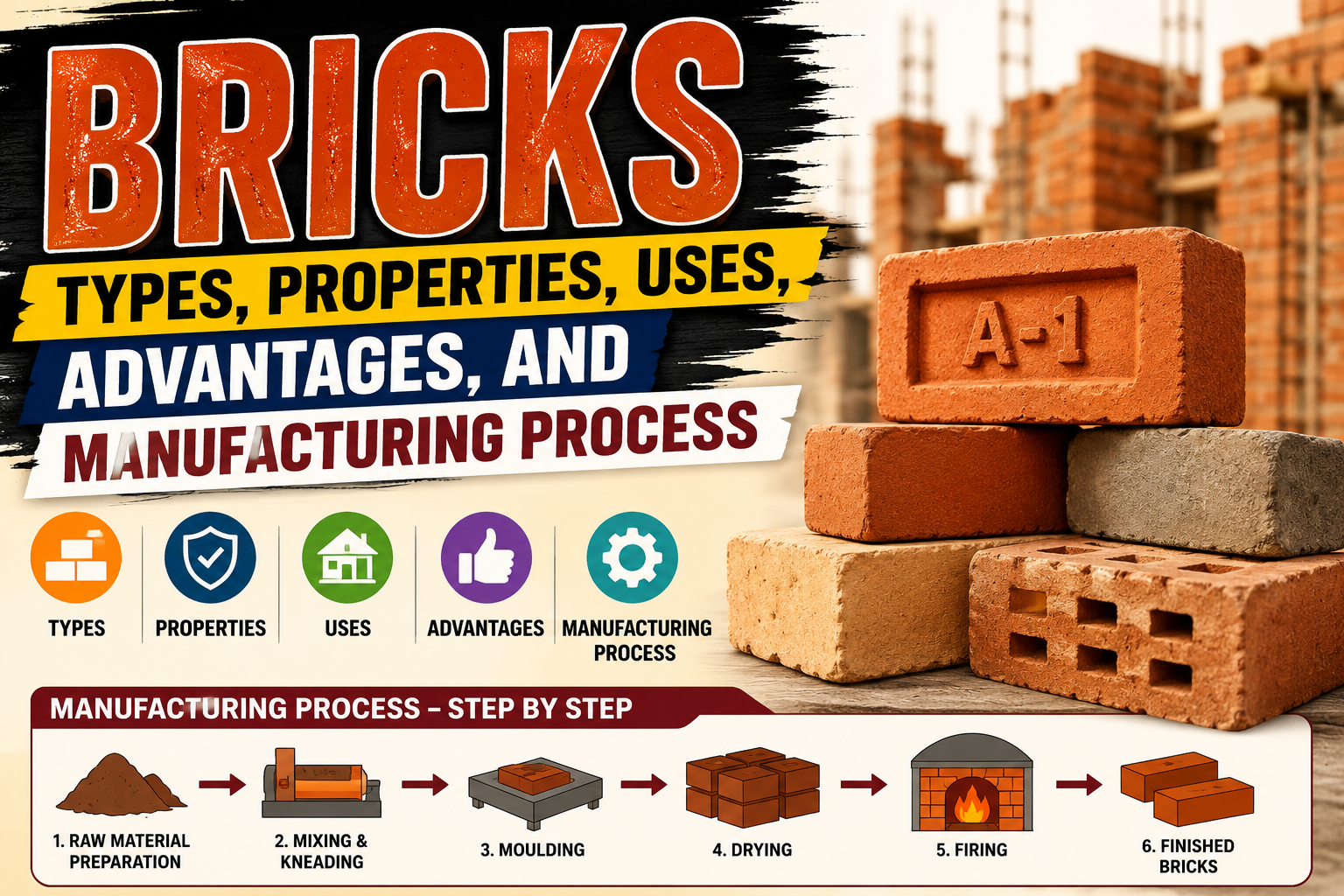
Manufacturing Process of Bricks
The manufacturing of bricks involves several important steps.
1. Preparation of Clay
Clay is cleaned and mixed properly to remove impurities.
2. Molding
Clay is molded into brick shapes manually or using machines.
3. Drying
The molded bricks are dried to remove moisture.
Importance of Drying
- Prevents cracks
- Improves strength
- Reduces shrinkage
4. Burning
Bricks are burned in kilns at high temperatures.
Benefits of Burning
- Increases hardness
- Improves durability
- Enhances strength
Tests on Bricks
Several tests are performed to check brick quality.
Common Brick Tests
| Test | Purpose |
| Water Absorption Test | Measures water absorption capacity |
| Compression Test | Checks strength |
| Hardness Test | Determines resistance to scratches |
| Soundness Test | Checks quality by sound |
| Shape and Size Test | Verifies dimensions |
Uses of Bricks
Bricks are widely used in construction works.
Common Uses
- Building walls
- Foundations
- Pavements
- Boundary walls
- Arches
- Chimneys
- Drain construction
Advantages of Bricks
Benefits of Using Bricks
- Strong and durable
- Fire-resistant
- Good thermal insulation
- Easily available
- Economical
- Low maintenance
- Recyclable material
Disadvantages of Bricks
Despite many advantages, bricks also have some limitations.
Limitations
- Heavy weight
- Time-consuming construction
- Low tensile strength
- Not suitable for very high-rise buildings
Brick Masonry
Brick masonry is the arrangement of bricks using mortar.
Types of Brick Bonds
| Bond Type | Description |
| Stretcher Bond | Bricks placed lengthwise |
| Header Bond | Bricks placed widthwise |
| English Bond | Alternate header and stretcher courses |
| Flemish Bond | Headers and stretchers in the same course |
Compressive Strength Formula of Bricks
The compressive strength of a brick is calculated using the following formula:
$$ \text{Compressive Strength} = \frac{\text{Load}}{\text{Area}} $$
Explanation
- Load = Maximum load applied on the brick
- Area = Loaded area of the brick
The result is usually expressed in N/mm².
Real-Life Example of Bricks
Bricks are commonly used in residential houses because they provide good strength and insulation. Many traditional homes in India are built using burnt clay bricks due to their affordability and durability.
Conclusion
Bricks are one of the most essential construction materials used worldwide. They are durable, strong, economical, and suitable for various types of construction work. Different types of bricks are available for different engineering needs, such as fly ash bricks, concrete bricks, and fire bricks.
Understanding the properties, manufacturing process, and uses of bricks is very important for civil engineering students, builders, and construction professionals.
FAQs About Bricks
1. What are bricks made of?
Bricks are mainly made from clay, sand, lime, cement, or fly ash.
2. Which brick is best for house construction?
First-class burnt clay bricks and fly ash bricks are commonly preferred for house construction.
3. What is the standard size of a brick?
The standard modular brick size is 190 mm × 90 mm × 90 mm.
4. Why are fly ash bricks popular?
Fly ash bricks are lightweight, eco-friendly, and have good strength.
5. What is brick masonry?
Brick masonry is the process of arranging bricks using mortar to build structures.
About the Author